Frozen Evaporator Coil in a Mild Coastal Climate: Causes
July 23, 2026

Why a Frozen Evaporator Coil in a Mild Coastal Climate Happens — and What Causes It
A frozen evaporator coil in a mild coastal climate what causes it is one of the most misunderstood HVAC problems homeowners in Torrance, Rancho Palos Verdes, and the South Bay face. Most people assume freezing coils only happen in hot, dusty desert regions — but the reality is that mild coastal conditions create their own set of triggers that are just as damaging, and often harder to spot.
The most common causes include:
- Dirty air filters that block airflow and drop coil temperature below 32°F
- Salt air corrosion that creates micro-leaks in copper tubing, slowly reducing refrigerant charge
- High coastal humidity that dramatically increases the condensation load on the coil, leaving zero margin for any airflow restriction
- Blower motor or capacitor failures that reduce fan speed and starve the coil of warm return air
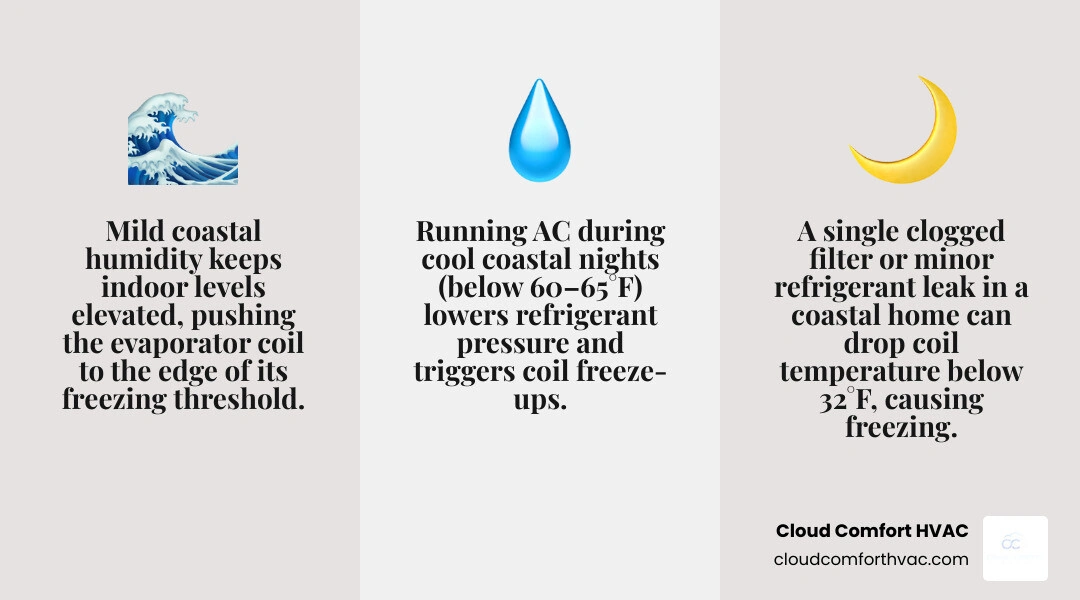
- Running the AC during cool coastal nights when outdoor temperatures dip below 60–65°F, causing refrigerant pressure to fall too low
- Undersized or retrofitted ductwork common in older South Bay homes that restricts airflow to the evaporator
The marine layer that rolls in off the Pacific each morning is not just a nuisance — it keeps indoor humidity levels elevated and pushes the evaporator coil right to the edge of its freezing threshold. A single clogged filter or a minor refrigerant leak is all it takes to push it over.
As a coastal homeowner, this is not a problem you can ignore. A frozen coil stops your AC from cooling, accelerates compressor wear, and can cause water damage inside your home as the ice melts. Every hour a frozen system keeps running increases the risk of an expensive compressor failure.
I'm Isidro Davalos, and in this guide I'll walk you through exactly what causes a frozen evaporator coil in a coastal climate, how to diagnose it correctly, and what to do next.
Basic frozen evaporator coil in a mild coastal climate what causes it glossary:
- AC troubleshooting before calling a pro
- AC not cooling but running what to check first in the South Bay
- AC keeps turning on and off what is wrong
Frozen Evaporator Coil in a Mild Coastal Climate What Causes It?

To understand why an air conditioning system freezes in a mild coastal area like Manhattan Beach or Palos Verdes Estates, we have to look at the unique relationship between temperature, pressure, and coastal moisture.
In a standard air conditioning cycle, the indoor evaporator coil acts as a heat exchanger. Cold refrigerant flows through the copper or aluminum tubing of the coil. As warm, humid indoor air is blown across these fins, the refrigerant absorbs the heat from the air, cooling your home. Because the coil is cold, moisture from the humid indoor air condenses on the surface of the metal fins — much like water droplets forming on a cold glass of iced tea on a summer afternoon.
Under normal operating conditions, this coil should run at approximately 40°F. At this temperature, the water droplets remain liquid, trickling down the fins into a condensate drain pan, which safely carries the water outside.
However, if the temperature of the coil drops to 32°F or lower, the physical process of dehumidification takes a dangerous turn. The condensation on the coil transitions from drop-wise liquid to crystal nucleation. This thin layer of frost acts as an insulator, restricting heat transfer. As the ice layer grows thicker, it physically blocks the spaces between the aluminum fins, choking off airflow. With even less warm air passing over the coil, the temperature plummets further, turning the entire indoor unit into a solid block of ice.
In our local coastal climate, two environmental factors dramatically accelerate this freezing process:
1. High Coastal Humidity and the Condensation Load
In dry climates, an evaporator coil has very little moisture to contend with. In coastal cities like Hermosa Beach and Redondo Beach, the marine layer brings high relative humidity. This means your AC system extracts massive volumes of water from the air — sometimes between 5 and 20 gallons of water per day.
Because the moisture load is so high, the evaporator coil is constantly saturated. If an airflow restriction or a refrigerant issue causes the coil temperature to drop even slightly below 32°F, that massive volume of water freezes almost instantly. There is simply zero margin for error.
2. Salt Air Exposure and Formicary Corrosion
Homes located within three miles of the Pacific coast experience constant exposure to salt-laden ocean air. When salt spray and high humidity mix, they form a highly corrosive, sticky residue on both outdoor and indoor components.
For the indoor evaporator coil, this salt air triggers a specific type of chemical degradation known as Formicary corrosion. This occurs when organic acids in the indoor air react with the copper tubing of the coil in the presence of moisture, creating microscopic, pinhole leaks. These tiny leaks allow refrigerant to slowly escape over months or years. As the refrigerant level drops, so does the system's pressure, dragging the coil's temperature down below the freezing mark.
To learn more about how our coastal environment impacts your system, check out our detailed guide on How Salt Air Exposure Shortens AC Lifespan Near the Torrance and South Bay Coast.
Airflow Restrictions: The Primary Frozen Evaporator Coil in a Mild Coastal Climate What Causes It Trigger
By far, the most common trigger for a frozen evaporator coil is restricted airflow. If there isn't enough warm air blowing across the coil to keep its surface temperature above 32°F, the moisture on the fins will freeze.
The Impact of Dirty Air Filters
A dirty air filter is the single most preventable cause of AC system failure. Many homeowners believe that filters are designed to last three months. However, in coastal areas where damp air can cause dust and pollen to clump together on the filter surface, a filter can become clogged much faster.
A heavily soiled filter can easily reduce system airflow by 40 percent or more. This restriction increases the static pressure inside your ductwork, forcing the blower motor to work harder while delivering less air to the coil. Without a steady stream of warm indoor air to heat the refrigerant inside the coil, the coil’s temperature drops rapidly below freezing. For a deeper look at this summer phenomenon, read our article on Why Is My AC Freezing Up in the Summer Heat?.
Closed Registers and Blocked Return Grilles
We often encounter homeowners who close supply registers in unused rooms in an attempt to save energy. This is a major misconception. Central HVAC systems are carefully engineered to maintain a precise balance of airflow and static pressure.
When you close more than 20 to 30 percent of your home's supply registers, you restrict the system's ability to release air. This increases the static pressure in the supply plenum, backing up air and starving the evaporator coil. Similarly, blocking return air grilles with furniture, heavy drapes, or doors prevents the system from pulling enough warm air out of your living spaces, leading to the exact same freezing cycle.
Low Refrigerant: A Common Frozen Evaporator Coil in a Mild Coastal Climate What Causes It Issue
A common misconception is that if an air conditioner is freezing up, it must have "too much cold" inside it, or that adding more refrigerant will solve the problem. In reality, a frozen coil is frequently caused by a low refrigerant charge.
The Thermodynamics of Low Refrigerant
To understand why low refrigerant causes freezing, we have to look at how pressure and temperature interact inside a closed loop:
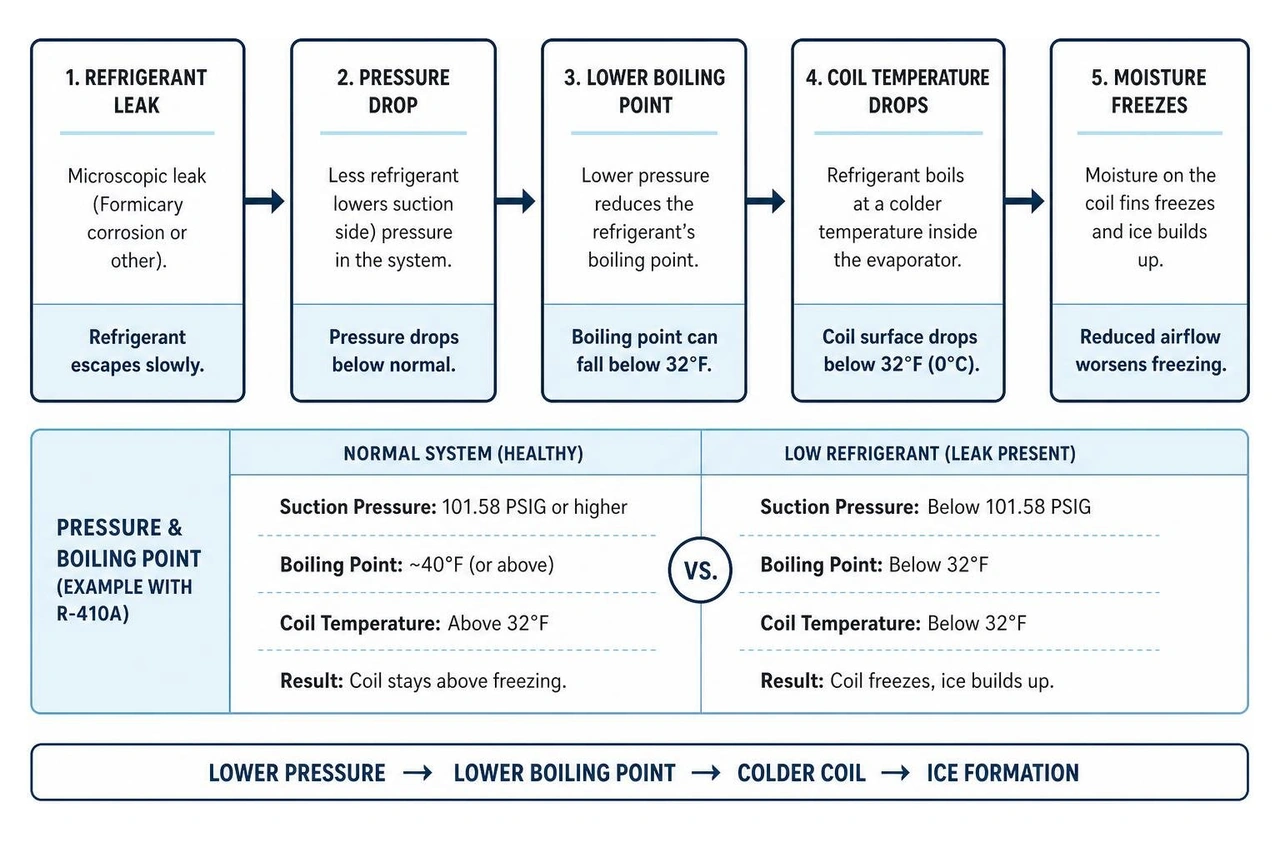
- Pressure Drop: When there is a leak in the system, the overall volume of refrigerant decreases, which causes the operating pressure on the suction side (the low-pressure side) of the system to drop.
- Lower Boiling Point: According to the laws of physics, lowering the pressure of a fluid lowers its boiling point. In a healthy system running R-410A refrigerant, the pressure should keep the boiling point around 40°F. If a leak drops the suction pressure below 101.58 PSIG, the boiling point of the remaining refrigerant drops below 32°F.
- Over-Expansion: As the liquid refrigerant enters the evaporator coil through the metering device (like a TXV), it over-expands because of the low pressure. This causes it to vaporize immediately at the very beginning of the coil, absorbing heat too quickly in one localized spot.
- Localized Freezing: The temperature at the inlet of the coil plummets far below freezing. Moisture in the air freezes instantly upon contact with this section of the coil.
- Full Freeze-Up: This localized ice block begins to restrict airflow across the rest of the coil. With less airflow, the freezing effect quickly cascades across the entire evaporator assembly until it is completely encased in ice.
Diagnosing Refrigerant Leaks
Diagnosing a refrigerant issue is not a DIY job. It requires measuring "superheat" (the temperature rise of the refrigerant after it evaporates) and "subcooling" (the temperature drop of the liquid refrigerant after it condenses). A system with a low refrigerant charge will display high superheat at the evaporator and low subcooling at the condenser.
Furthermore, EPA Section 608 protocols strictly regulate the handling, recovery, and charging of refrigerants. If your system has a leak, simply topping off the refrigerant is a temporary, illegal, and environmentally harmful practice. The leak must be located (often using electronic leak detectors or nitrogen pressure testing), repaired by brazing the copper lines, and the system must be evacuated to a deep vacuum before being recharged with the precise weight of refrigerant specified by the manufacturer.
Mechanical Failures and Local Building Stock Challenges
While dirty filters and slow leaks are common culprits, mechanical failures and the unique architecture of our local South Bay homes often play a major role in evaporator coil freezing.
Blower Motor Failures and Weak Capacitors
The blower motor is the heart of your home's airflow system. If the motor fails completely, airflow stops, and the coil freezes within minutes. However, a more insidious issue is a failing blower motor or a weak run capacitor.
A run capacitor provides the continuous electrical phase shift needed to keep the blower motor spinning at its designed speed. Over time, heat and electrical wear can cause a capacitor to degrade. A weak capacitor can reduce blower motor speed by up to 30 percent. This subtle drop in fan speed reduces the cubic feet per minute (CFM) of air moving across your coil below the minimum threshold required to prevent freezing, causing mysterious, intermittent ice buildup that is hard for homeowners to diagnose.
Local Building Stock and Retrofitted Ductwork
The local housing stock in coastal communities like Torrance, Culver City, and Carson varies wildly. We have beautiful historic homes built in the 1920s through the 1950s, many of which were never originally designed to accommodate central air conditioning.
When modern AC systems are retrofitted into these older homes, installers are often forced to squeeze ductwork into tight crawlspaces, narrow joist bays, or small closets. This historic retrofitting introduces several chronic risks:
- Undersized Return Air Grilles: Modern high-efficiency systems require substantial return airflow. If an older home is retrofitted with only a single, undersized return grille (for example, trying to pull air for a 3-ton system through a single 14x20 grille), it creates massive negative pressure. This starves the blower and drops coil temperatures.
- Crushed or Restriced Flex Duct: Flexible ductwork run through tight, unconditioned crawlspaces can easily become pinched, kinked, or crushed by settling home structures or storage boxes. A single crushed duct run can cut off airflow to an entire section of the home, driving up static pressure and freezing the coil.
- Static Pressure Imbalances: Poorly designed duct systems create high static pressure, which acts like a clog in your system's respiratory tract. Over time, this imbalance not only causes the coil to freeze but also burns out blower motors prematurely.
How to Safely Thaw and Diagnose a Frozen AC Unit
If you walk past your indoor air handler and notice ice coating the copper lines or water dripping from the cabinet, you must act quickly to prevent serious damage.
Step-by-Step Safe Thawing Process
Never attempt to speed up the thawing process by scraping the ice with a screwdriver, knife, or other tools. The aluminum fins on your evaporator coil are incredibly fragile and easily bent, and a slip of a tool can easily puncture the copper refrigerant lines, leading to an expensive repair. Similarly, avoid using high-heat sources like hair dryers or heat guns, which can cause thermal shock and warp the metal components.
Instead, follow this safe, step-by-step thawing method:
- Shut Off the Cooling: Turn your thermostat system setting to "OFF" immediately. This stops the compressor from running and prevents further ice accumulation.
- Switch Fan to "ON": Change your thermostat's fan setting from "AUTO" to "ON". This forces the indoor blower motor to run continuously, circulating warm, room-temperature air over the frozen coil to melt the ice safely.
- Manage the Meltwater: A frozen coil holds a massive amount of water. As it melts, the volume can easily overwhelm your condensate drain pan. Place plenty of dry towels around the base of your indoor unit, or use a shop vac to clear water from the drain pan as it melts.
- Wait Patiently: Depending on the thickness of the ice, thawing can take anywhere from 2 to 8 hours. Do not attempt to turn the cooling back on until the ice is completely gone from both the indoor coil and the outdoor copper lines.
Diagnosing the Root Cause
Once the system is completely thawed, you need to determine whether the issue is airflow-related or refrigerant-related. A healthy system should show a 15 to 20-degree temperature drop (temperature split) between the return air entering the system and the supply air leaving the registers.
Here is a helpful diagnostic breakdown to help you identify the culprit:
| Symptom / Test | Airflow-Related Freeze | Refrigerant-Related Freeze |
|---|---|---|
| Air Filter Condition | Extremely dirty, gray, or clogged | Clean or brand new |
| Blower Fan Operation | Weak air coming from vents; fan motor humming or silent | Strong, consistent airflow from vents |
| Ice Location | Uniform ice coating across the entire evaporator coil | Heavy ice starting at the expansion valve / inlet |
| Temperature Split | Very high (over 22°F drop due to slow-moving air) | Very low (under 12°F drop; system blows lukewarm air) |
| System Pressures | Low suction pressure, normal/high superheat | Low suction pressure, very high superheat, low subcooling |
If you've checked your filters and vents and your system is still struggling, read our guide on AC Troubleshooting Before Calling a Pro for more step-by-step checks.
The Dangers of Running an AC with a Frozen Coil and When to Call a Pro
It can be tempting to let your AC run even if it is partially frozen, hoping it will "blow through the ice." This is one of the most dangerous things you can do to your HVAC system.
The Threat of Compressor Damage and Liquid Slugging
The compressor is the most expensive component in your air conditioning system. It is designed to compress vaporized refrigerant, not liquid.
When your evaporator coil is covered in ice, the refrigerant flowing through it cannot absorb heat from your home's air. As a result, the refrigerant remains a cold liquid instead of boiling off into a gas. This liquid refrigerant flows back down the suction line directly into the compressor.
This destructive process is known as liquid slugging. Because liquids cannot be compressed, this causes severe hydraulic shock inside the compressor. It can instantly shatter piston rods, damage valve reeds, wash out the lubricating oil, and cause total mechanical failure of the compressor motor. Replacing a ruined compressor can cost thousands of dollars.
The 3-Minute Rule and the $5,000 Rule
To protect your system from catastrophic failures, we always recommend keeping two critical rules in mind:
- The 3-Minute Rule: If your system shuts off, or if you turn it off manually during a freeze event, always wait at least three to five minutes before restarting it. This delay allows the high and low refrigerant pressures inside the system to fully equalize, protecting the compressor motor from starting under high load and short-cycling.
- The $5,000 Rule: If your system is older and experiencing a major failure (like a frozen coil caused by a rusted, leaking evaporator coil), use this calculation: multiply the repair estimate by the age of the system in years. If the total exceeds $5,000, investing in a new, energy-efficient system with a strong warranty is almost always the more financially sensible choice.
Preventive Maintenance Steps
In our mild coastal climate, proactive maintenance is the key to preventing ice build-up. Because coastal humidity and salt air cause dust and grime to bond tightly to metal surfaces, we recommend cleaning your evaporator coils every six months. This is much more frequent than the standard two-year recommendation for dry inland areas, but it is essential for protecting your system from the elements.
To see how regular maintenance keeps your system running smoothly during unexpected weather shifts, read How AC Service Prevents Breakdowns When Offshore Heat Events Hit the South Bay.
Frequently Asked Questions About Frozen Evaporator Coils
How long does it take for a frozen evaporator coil to thaw completely?
If you turn your system completely off and switch the thermostat fan setting to "ON," a light layer of frost will usually melt within 1 to 3 hours. However, if your system has been running with a heavy freeze and is encased in a thick block of ice, it can take anywhere from 6 to 8 hours — and occasionally overnight — to thaw completely. Do not attempt to run the cooling mode until you are certain all ice has melted.
Can I run my AC if only the outdoor refrigerant lines are frozen?
No. If you see ice or frost on the copper refrigerant lines leading to your outdoor condenser unit, it is a clear sign that your indoor evaporator coil is already completely frozen. Continuing to run the system in this state will cause liquid refrigerant to flood back into the compressor, risking permanent mechanical failure. Shut down the system immediately.
Why does my home feel so humid when the AC coil is frozen?
A healthy air conditioner acts as a powerful dehumidifier. However, when the evaporator coil freezes, the ice forms a physical barrier between the cold metal and the passing air. The air blowing through your vents can no longer drop its moisture on the coil. Even worse, the warm air passing over the melting ice picks up that moisture and blows it right back into your living spaces, making your home feel incredibly warm, sticky, and humid.
Conclusion
A frozen evaporator coil is a complex symptom of an underlying airflow or pressure imbalance that requires careful, professional attention. Whether your system is struggling with salt-air induced micro-leaks, retrofitted ductwork restrictions, or a failing blower component, ignoring the warning signs can quickly lead to a system breakdown.
At Cloud Comfort HVAC, we specialize in providing expert, eco-friendly climate solutions tailored specifically to the unique challenges of coastal Southern California homes. We serve Torrance, Manhattan Beach, Culver City, Carson, and the surrounding South Bay communities with fast, reliable service and transparent pricing.
As a proud Daikin dealer, we offer industry-leading warranties and our signature 1-year Comfort Promise to give you complete peace of mind. If your air conditioner is freezing up or struggling to keep your home comfortable, don't wait for a minor issue to turn into an expensive compressor replacement. Contact us today to schedule our Professional AC Repair Services and let our expert team restore clean, reliable comfort to your home.
Have an HVAC or plumbing question?
Our Torrance comfort experts are here to help — no pressure, just honest answers.
Ask an Expert