How AC Service Prevents Breakdowns When Offshore Heat Events Hit the South Bay
July 16, 2026

When Offshore Heat Hits the South Bay, Your AC Has No Room for Error
Understanding how AC service prevents breakdowns when offshore heat events hit the South Bay starts with one uncomfortable truth: the systems most likely to fail on the hottest day of the year are the ones that haven't been serviced recently.
Here's a quick answer if you need it now:
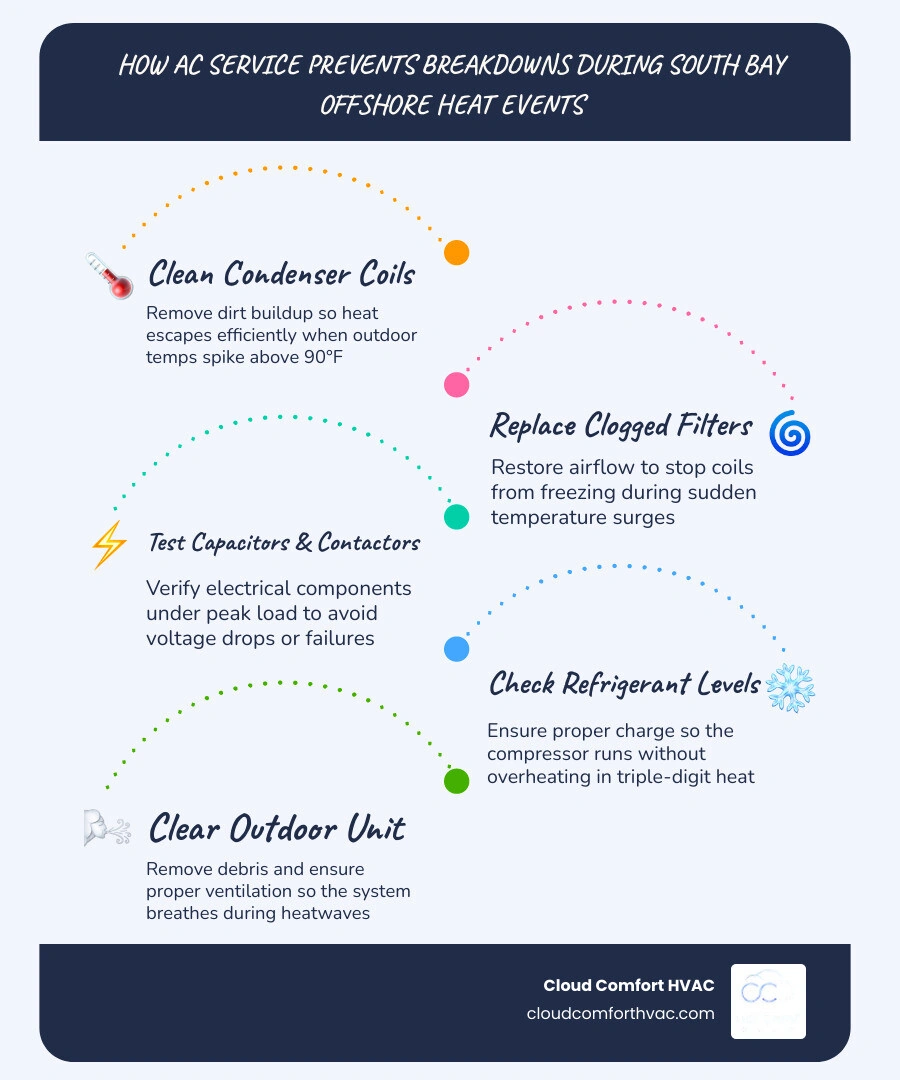
AC service prevents heat wave breakdowns by:
- Cleaning condenser coils so heat can escape efficiently when outdoor temps spike
- Replacing clogged filters that restrict airflow and cause coils to freeze
- Testing capacitors and contactors before they fail under electrical stress
- Checking refrigerant levels so the compressor doesn't overheat under peak load
- Clearing the outdoor unit so the system can breathe during triple-digit heat
- Catching small problems early — before cumulative seasonal wear turns them into full breakdowns
The South Bay — including Torrance, Manhattan Beach, Rancho Palos Verdes, and Palos Verdes Estates — sits in a unique climate zone. Most days, a cool marine layer rolls in off the Pacific and keeps temperatures mild. But when a high-pressure system pushes offshore winds toward the coast, that marine layer gets shoved out to sea. Temperatures that rarely break 80°F can suddenly climb into the 90s or beyond — and your AC, which may not have run hard in weeks, gets slammed with maximum demand all at once.
That sudden surge is exactly when deferred maintenance catches up with homeowners. A filter that was "probably fine" in May becomes a frozen coil by July. A capacitor that was borderline in spring fails during the first real heat spike. The system didn't break overnight — it was already weakened, and the heat exposed it.
At Cloud Comfort HVAC, we serve homeowners and businesses across the South Bay who want to stay ahead of that moment, not scramble during it.
Essential how ac service prevents breakdowns when offshore heat events hit the south bay terms:
- ac service — what it includes and when to schedule it
- how often should you get ac service in a coastal southern california home
- what does professional ac service include in the south bay and orange county area
Understanding Offshore Heat Events and Their Impact on the South Bay
To appreciate why our cooling systems struggle when the weather shifts, we have to look at the meteorology behind Southern California’s microclimates. Normally, cities like Manhattan Beach, Hermosa Beach, and Palos Verdes Estates enjoy a strong marine layer. This layer of cool, moist air acts as a natural shield, keeping coastal temperatures incredibly comfortable.
However, during an offshore heat event, a strong high-pressure system settles over the Great Basin or the deserts to our east. This system reverses our typical wind patterns. Instead of a cool breeze blowing inland from the ocean, dry, hot air rushes from the inland deserts toward the coast. As this air descends from the mountains, it compresses and warms up rapidly.
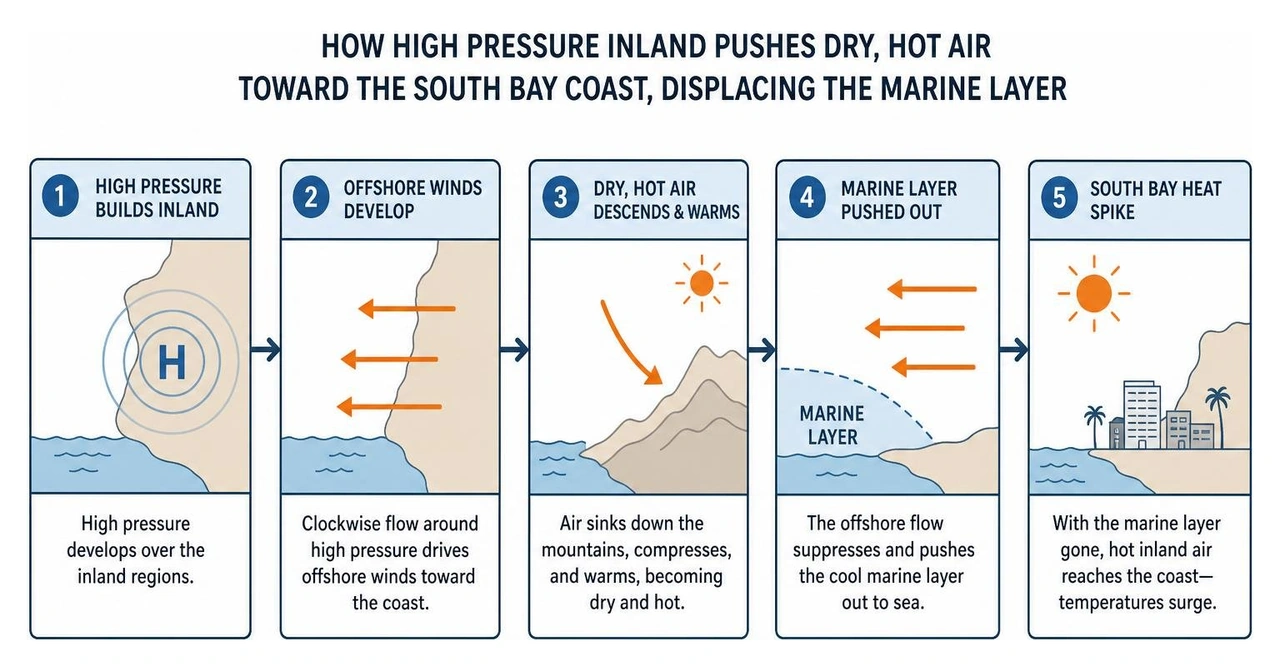
This offshore flow completely suppresses the marine layer, pushing it far out to sea. When this happens, our coastal shield is gone. Temperatures in coastal neighborhoods can skyrocket by 20°F to 30°F in a single afternoon. A home in Torrance or Redondo Beach that was perfectly comfortable at 72°F on Tuesday can suddenly face 95°F ambient heat on Wednesday.
This dramatic temperature spike places immense stress on residential cooling systems. Because our coastal climate is typically so mild, many local air conditioners sit idle or run on very light cycles for months. When an offshore heat event strikes, these systems are forced to transition instantly from zero to maximum capacity.
Furthermore, homes located closer to the ocean face a unique double threat. The salt-laden coastal air accelerates corrosion on metal components, particularly the delicate aluminum fins of the outdoor condenser coils. This coastal wear makes regular maintenance even more critical than it is for inland properties. If you want to dive deeper into how our coastal environment impacts your system's needs, check out our guide on How Often Should You Get AC Service in a Coastal Southern California Home.
How AC Service Prevents Breakdowns When Offshore Heat Events Hit the South Bay
Air conditioning systems do not actually "create" cold air; instead, they extract heat from inside your home and dump it outdoors. This heat transfer process relies on clean coils, balanced refrigerant levels, and robust electrical components. When we perform professional AC service, we are optimizing every single stage of this thermodynamic process.
During an offshore heat wave, your AC must work much harder to reject indoor heat into the already scorching outdoor air. If your outdoor condenser coils are coated in a layer of dust, salt spray, or dry debris, they act like an insulating blanket. The heat remains trapped inside the system, forcing the compressor to run longer, hotter cycles to achieve the same cooling effect.
Regular maintenance addresses this "cumulative load" problem. By thoroughly cleaning the condenser coils, checking electrical connections, and verifying airflow, we ensure your system can reject heat efficiently. This direct optimization translates to:
- Substantially Lower PG&E Bills: A clean, maintained system is 15% to 25% more energy-efficient, preventing the massive utility bill spikes that typically accompany summer heatwaves.
- Reduced Component Wear: When your system runs shorter, more efficient cycles, it experiences less physical wear and tear.
- Extended Equipment Lifespan: While a neglected air conditioner might only last 10 to 12 years under the stress of South Bay weather, a well-maintained system can easily keep your home comfortable for 15 to 20 years.
To learn more about how a comprehensive spring tune-up prepares your cooling system for these sudden weather shifts, read our detailed article on How An AC Tune-Up Prepares Your System for Offshore Heat Events in the South Bay.
How AC Service Prevents Breakdowns When Offshore Heat Events Hit the South Bay for Homeowners
For residential properties in Torrance, Manhattan Beach, and Rancho Palos Verdes, a sudden breakdown during a heatwave is more than just an inconvenience—it can quickly turn your home into an oven. Many residential systems in our area are older or have been retrofitted into homes that were not originally designed with central air conditioning. These homes often feature single-stage systems that must run continuously to combat extreme heat.
When we provide dedicated Air Conditioning Services in Torrance CA, we don't just look at the equipment; we evaluate your entire home's cooling envelope. We check for duct leaks in hot attics, ensure return vents are completely unblocked, and verify that your system is balanced to handle the unique layout of your property. Proactive residential service ensures that your family stays safe and comfortable, avoiding the stress of waiting days for emergency repairs when local HVAC companies are completely booked.
How AC Service Prevents Breakdowns When Offshore Heat Events Hit the South Bay for Commercial Properties
Commercial HVAC systems in the South Bay face an entirely different set of challenges during offshore heat events. Whether you run a retail shop in Manhattan Beach, an office space in Culver City, or a commercial facility in Carson, your cooling system has to battle both the outdoor weather and massive internal heat loads.
High occupancy levels, running computers, commercial lighting, and specialized equipment all generate substantial internal heat. When an offshore heat wave hits, the cooling load can double instantly. If a commercial rooftop unit fails, it doesn't just cause discomfort—it threatens business continuity, compromises indoor air quality, forces employees home, and can even damage heat-sensitive inventory or server rooms.
Regular commercial AC service focuses on heavy-duty components, belt replacements, belt tension adjustments, and thorough electrical diagnostics. Keeping these systems optimized ensures your business stays open, your customers remain comfortable, and your overhead costs stay manageable even when utility rates spike.
Common Summer AC Failures and Their Warning Signs
When an air conditioner breaks down during a heatwave, it rarely happens without warning. Most failures are the result of small, unchecked issues that gradually worsen over several months. By learning to recognize the early warning signs, you can schedule a professional repair before your system shuts down completely. If you are already noticing some of these issues, you may need to schedule a prompt AC Repair Manhattan Beach CA visit to protect your system.
Electrical Component Failures
Your air conditioner relies on several critical electrical components to start and run its powerful motors. The most common point of failure during a heatwave is the run capacitor. Think of the capacitor as a temporary battery that delivers the extra electrical boost your compressor and fan motor need to start and run efficiently.
Extreme heat is the natural enemy of electrical components. When outdoor temperatures climb, the internal materials of your capacitors degrade rapidly. If a capacitor is already weakened from years of service, the sustained high temperatures of an offshore heat event will often cause it to swell, leak, or fail entirely.
Warning Signs of Electrical Failure:
- A loud buzzing or clicking sound coming from the outdoor unit when it tries to start.
- The outdoor fan is running, but the compressor is not, resulting in warm air blowing from your vents.
- Your home's circuit breaker trips repeatedly when the AC cycles on.
Airflow Restrictions and Frozen Coils
For your air conditioner to cool your home, it must blow warm indoor air across an incredibly cold evaporator coil located inside your home. If anything restricts this airflow, the heat transfer process breaks down.
When airflow is restricted, the temperature of the evaporator coil will drop below freezing. The moisture that your system naturally extracts from the air will instantly freeze on the coil's surface. As ice builds up, it acts as an insulating barrier, completely blocking any remaining airflow and eventually causing the entire system to shut down.
Warning Signs of Airflow Issues:
- A noticeable drop in the strength of the air coming out of your supply registers.
- Warm air blowing from your vents while the system runs continuously.
- Ice forming on the copper refrigerant lines leading to your outdoor unit, or water pooling around your indoor furnace or air handler.
Refrigerant Leaks and Compressor Stress
Refrigerant is the lifeblood of your air conditioning system. It circulates between the indoor and outdoor units, absorbing heat from your home and releasing it outside. A common myth is that air conditioners "use up" refrigerant over time. In reality, your AC is a sealed system; if your refrigerant is low, you have a leak.
During a heatwave, a system with low refrigerant must work twice as hard to cool your home. This forces the compressor—the most expensive and critical component in your system—to run at extremely high temperatures and pressures. Over time, this intense thermal stress will trigger the compressor's internal safety switches, causing it to shut down to prevent a catastrophic blowout.
Warning Signs of Refrigerant Issues:
- Your system runs continuously for hours but the indoor temperature refuses to drop.
- A persistent hissing or bubbling noise coming from the indoor or outdoor unit.
- Uneven temperatures throughout your home, with some rooms feeling significantly warmer than others.
Your Pre-Season Maintenance Checklist to Prepare for Extreme Heat
The absolute best way to survive a South Bay heatwave is to prepare your system well in advance. While some basic maintenance tasks can be completed by handy homeowners, a truly reliable system requires professional diagnostic testing.
| Maintenance Task | DIY Friendly? | What It Accomplishes |
|---|---|---|
| Replace Air Filters | Yes | Restores optimal airflow, protects indoor air quality, and prevents frozen coils. |
| Clear Outdoor Clearance | Yes | Ensures the outdoor condenser has a 2-foot breathing zone to reject heat. |
| Gently Rinse Condenser Coils | Yes | Removes loose dust, pollen, and surface dirt from the outdoor unit. |
| Test Thermostat Accuracy | Yes | Verifies that your system is responding correctly to temperature changes. |
| Test Capacitors & Electrical | No (Professional Only) | Measures electrical capacitance to catch failing parts before they cause a breakdown. |
| Verify Refrigerant Charge | No (Professional Only) | Ensures optimal system pressure and detects dangerous leaks early. |
| Clean Evaporator Coils | No (Professional Only) | Thoroughly cleans hard-to-reach indoor coils to maximize heat transfer. |
| Clear Condensate Drain Lines | No (Professional Only) | Flushes out algae and debris to prevent water damage and system shutoffs. |
DIY Steps You Can Take Today
You don't have to wait for a professional visit to start protecting your system. Here are four simple steps you can take today to reduce the stress on your air conditioner:
- Replace Your Air Filter: Check your filter every 30 to 60 days during the peak cooling season. If you have pets, or if our area has recently experienced wildfire smoke, you may need to replace it even more frequently. Always use a high-quality filter that balances filtration with optimal airflow.
- Maintain Outdoor Clearance: Walk outside and inspect your outdoor condenser unit. Ensure there is at least a two-foot clearance around the entire unit. Trim back any overgrown bushes, weeds, or low-hanging branches that could restrict airflow.
- Clear Loose Debris: Gently remove any leaves, twigs, or dirt that have accumulated on top of or around the outdoor unit. You can use a standard garden hose with a gentle spray setting to rinse away loose dust from the metal fins. Never use a pressure washer, as the high pressure will instantly bend and damage the delicate aluminum fins.
- Optimize Your Thermostat: Avoid the temptation to crank your thermostat down to 65°F when an offshore heat event hits. This will not cool your home any faster; it simply forces your system to run longer, high-stress cycles. Instead, set your thermostat to a reasonable 78°F when you are home, and use ceiling fans to create a comfortable breeze.
What Professional AC Service Includes
While DIY steps are a fantastic starting point, they cannot replace the deep diagnostic testing of a professional tune-up. When our certified technicians service your system, we use specialized tools to inspect components that are completely inaccessible to homeowners.
Our comprehensive professional service includes checking electrical connections, measuring voltage and motor amp draws, verifying correct refrigerant levels, inspecting the indoor evaporator coil, testing safety controls, and clearing the condensate drain line to prevent water damage. To see a complete breakdown of what our team does during a maintenance visit, read our guide on What Does Professional AC Service Include in the South Bay and Orange County Area.
Frequently Asked Questions About South Bay Heatwaves and AC Performance
Why does my AC stop cooling during an offshore heat event?
Your air conditioner likely stopped cooling because one of its safety sensors triggered a system shutoff, or a critical component failed under the extreme thermal load. When outdoor temperatures spike, your system's internal operating pressures rise significantly.
If your outdoor coils are dirty, or if your system is low on refrigerant, the compressor will quickly overheat. To prevent permanent damage or a fire hazard, the system's thermal overload switch will trip, shutting the compressor down. Additionally, restricted airflow from a clogged filter can cause the indoor coil to freeze, completely blocking the flow of cool air into your home.
Is it safe to run my AC continuously during a triple-digit heatwave?
Yes, it is entirely safe and normal for a properly sized, well-maintained air conditioner to run continuously during the hottest hours of a triple-digit heatwave. Modern systems are designed to handle extended runtimes.
In fact, if you have a modern variable-speed or inverter-driven system, running continuously at a lower, more efficient speed is exactly how the system was designed to operate. It maintains a consistent, comfortable temperature while using significantly less energy than a traditional system that constantly cycles on and off. Just make sure your filters are clean and the outdoor unit has plenty of breathing room!
What should I do if my AC fails during an active heatwave?
If your system stops cooling during an extreme heat event, follow these quick troubleshooting steps before calling for service:
- Check Your Thermostat: Ensure the thermostat is set to "Cool" and the fan is set to "Auto" or "On." If the screen is blank, replace the batteries.
- Inspect Your Circuit Breaker: Check your home's main electrical panel to see if the circuit breaker labeled "AC" or "HVAC" has tripped. If it has, flip it completely to the "Off" position, then back to "On." If it trips a second time, do not reset it again; call us immediately.
- Check the Air Filter: A completely clogged filter can cause the system to shut down. If the filter is dirty, replace it immediately. If you notice ice on the copper lines, turn the system to "Off" and set the indoor fan to "On" to help melt the ice.
- Keep Your Home Cool: While waiting for a technician, close all blinds and drapes on the sunny sides of your home. Use ceiling fans to keep air moving, and avoid using heat-producing appliances like the oven or dryer.
Conclusion
When the next offshore heat event hits the South Bay, you shouldn't have to worry about whether your air conditioner will make it through the day. By taking a proactive approach to maintenance, you can protect your home, lower your energy bills, and ensure your family stays cool and comfortable no matter how high the outdoor temperatures climb.
At Cloud Comfort HVAC, we are proud to provide expert, eco-friendly cooling solutions tailored specifically to our unique South Bay climate. Whether you need a quick pre-season tune-up or a complete system upgrade, our team is dedicated to delivering fast, reliable service with completely transparent pricing.
We stand behind our work with industry-leading Daikin warranties and our exclusive 1-year Comfort Promise. Don't wait for the next major heatwave to test your system's limits. Schedule Professional AC Maintenance in Hermosa Beach or your surrounding South Bay neighborhood today, and experience the peace of mind that comes with a truly reliable cooling system.
Have an HVAC or plumbing question?
Our Torrance comfort experts are here to help — no pressure, just honest answers.
Ask an Expert