Why Is My AC Blowing Warm Air When It Gets Hot in Coastal Southern California?
July 29, 2026

When Your AC Blows Warm Air in Coastal Southern California — Here's What's Actually Happening
If you're wondering why is my ac blowing warm air when it gets hot in coastal Southern California, you're not alone — and the answer usually comes down to one of a handful of common causes.
Quick Answer: Why Is My AC Blowing Warm Air in Coastal Southern California?
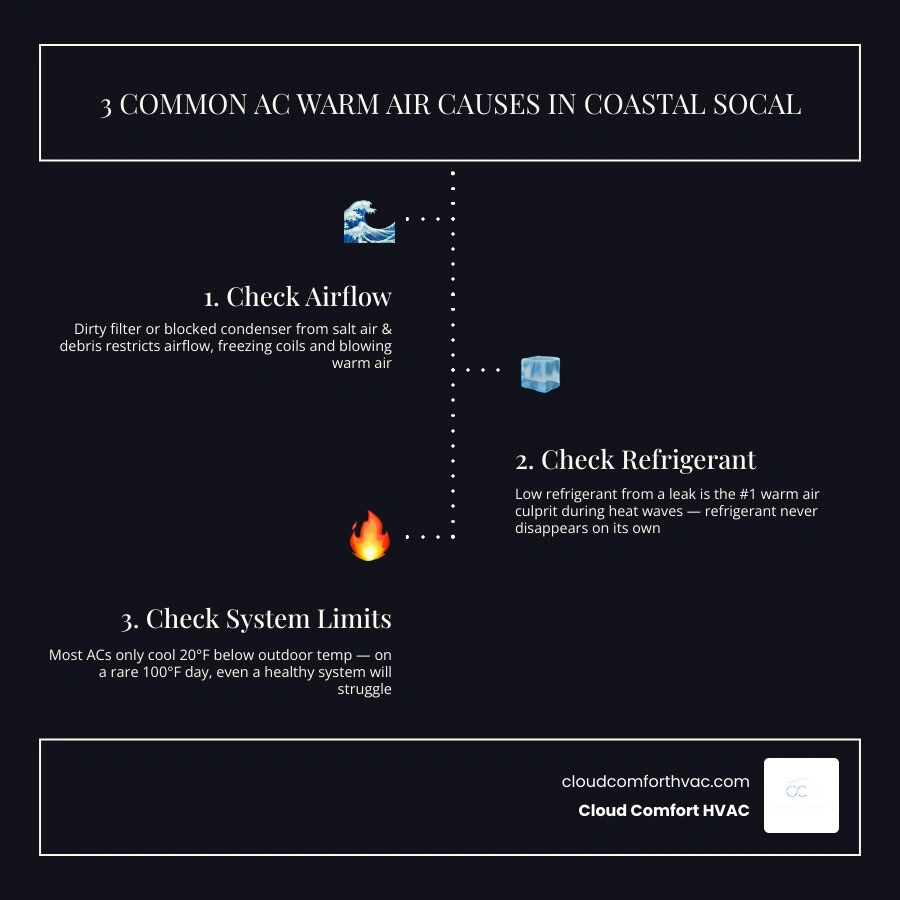
- Dirty or clogged air filter — restricts airflow and can freeze the evaporator coil, pushing uncooled air through your vents
- Low refrigerant due to a leak — the most common culprit during heat waves; refrigerant doesn't disappear on its own
- Dirty or blocked outdoor condenser — salt air, coastal fog, and debris coat the coils and choke heat transfer
- Thermostat set incorrectly — fan set to "On" instead of "Auto" circulates unconditioned air continuously
- Failing capacitor or compressor — electrical wear accelerates in high-heat conditions, especially in older systems
- System hitting its design limit — most residential AC units are only engineered to cool about 20°F below the outdoor temperature, so a rare 100°F day pushes any system to its edge
- Coastal-specific factors — salt air corrosion, marine layer humidity, and coastal microclimates put extra strain on equipment that inland systems never face
Coastal Southern California throws a unique mix of challenges at your AC system. The marine layer keeps mornings cool and evenings mild, but when a heat wave rolls through cities like Torrance, Manhattan Beach, or Rancho Palos Verdes, systems that sit idle for most of the year are suddenly asked to work at full capacity — often in conditions they weren't sized for. Add salt air corrosion on condenser coils, elevated humidity from the ocean, and the voltage sags that happen during peak demand hours, and you have a recipe for warm air coming out of vents right when you need relief the most.
I'm Isidro Davalos, and in this guide I'll walk you through exactly how to diagnose what's going wrong with your system and what you can do about it.
Simple why is my ac blowing warm air when it gets hot in coastal southern california word guide:
- ac troubleshooting before calling a pro
- ac not cooling but running what to check first in the south bay
- circuit breaker tripping when ac turns on what to do in a socal home
Why Is My AC Blowing Warm Air When It Gets Hot in Coastal Southern California?
When a heatwave hits the South Bay, homeowners who rarely turn on their cooling systems suddenly rush to the thermostat. If you flip the switch only to find lukewarm air drifting from the registers, the cause is often a combination of sudden extreme thermal load and electrical grid strain.
In coastal cities like Manhattan Beach and Torrance, the local climate is typically mild. Because of this, residential AC systems sit idle for months, gathering dust, pet dander, and ocean salt. When temperatures spike, the sudden thermal load forces the system to run continuously to achieve comfort. If there is an underlying issue like a weak capacitor, a dirty coil, or restricted airflow, the extreme heat will push these minor vulnerabilities into complete system failures.
Additionally, during widespread Southern California heatwaves, the local electrical grid experiences massive peak demand. This can cause brief voltage sags. These sags make it incredibly difficult for your outdoor condenser’s compressor to start or stay running. When the compressor shuts down due to electrical strain but your indoor blower motor continues to run, the system simply circulates uncooled indoor air.
If your air conditioner is running but the air is distinctly warm, it is critical to address the issue immediately. Running a struggling system in high heat can turn a minor, inexpensive electrical fix into a catastrophic compressor failure. For a step-by-step diagnostic breakdown, read our guide on What to Do When AC Is Blowing Warm Air and learn more about AC Not Cooling But Running – What to Check First in the South Bay.
Coastal Climate Factors: Salt Air, Humidity, and the 20-Degree Rule
Living near the Pacific Ocean is a dream, but the very factors that make our coastal microclimates so beautiful are incredibly tough on HVAC equipment.
First, let's look at the physics of air conditioning. Residential cooling systems are mathematically designed to cool indoor spaces to a maximum of 20 to 25 degrees Fahrenheit below the outdoor temperature. If it is a rare 100-degree day in Torrance or Rancho Palos Verdes, your air conditioner is operating perfectly according to its design limits if it keeps your indoor temperature around 75 to 80 degrees. Expecting a standard system to maintain 68 degrees when it is sizzling outside is simply beyond its physical capability.
Furthermore, high coastal humidity makes the cooling process significantly harder. An air conditioner must dehumidify the air before it can effectively lower the temperature. This means your system spends a massive amount of energy pulling moisture out of the marine layer air before you ever feel a drop in temperature.
To understand how these elements combine to damage your system over time, explore our detailed analysis of How Salt Air Exposure Shortens AC Lifespan Near the Torrance and South Bay Coast.
Understanding why is my ac blowing warm air when it gets hot in coastal southern california
The primary culprit behind premature HVAC failure along the coast is salt air corrosion. Ocean breezes carry microscopic salt particles that settle directly onto the delicate copper and aluminum fins of your outdoor condenser coil. Over time, this salt causes chemical corrosion known as coil pitting.
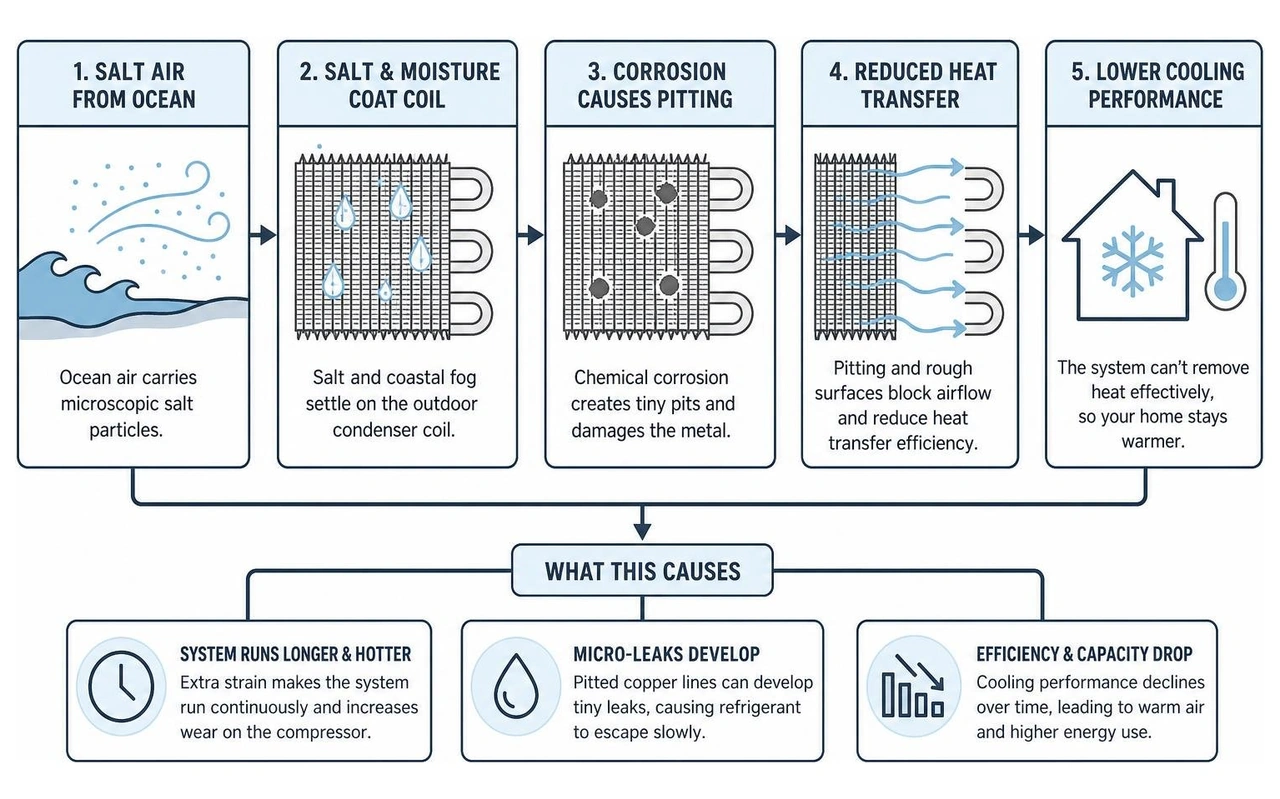
When coils corrode and pit:
- Heat transfer efficiency drops rapidly: The metal can no longer release heat into the outdoor air effectively.
- The system runs longer and hotter: This extra strain accelerates wear on the compressor.
- Micro-leaks develop: Refrigerant slowly escapes through the pitted copper lines.
Coastal fog also plays a role. When damp fog rolls in, it mixes with dust and salt on the condenser coils, creating a thick, crusty barrier. This barrier chokes the system's airflow, preventing proper heat transfer and ultimately causing the AC to blow warm air when a hot day finally arrives.
How to Diagnose the Issue: Dirty Filter, Low Refrigerant, or Failing Compressor?
Before you panic, it helps to understand that an air conditioner does not actually create cold air; it acts as a heat transfer system. If any part of this transfer process is interrupted, the system fails.
Let's look at three of the most common points of failure:
- Dirty Air Filter: A clogged filter restricts airflow across the indoor evaporator coil. When airflow is choked, the coil gets too cold and freezes solid. Once frozen, the ice acts as an insulator, preventing the system from absorbing heat. A clogged filter can restrict airflow and reduce system capacity by 40 percent, while increasing your cooling-cycle energy use by 5% to 15%.
- Low Refrigerant: Refrigerant operates in a sealed loop and does not get "used up" like fuel. If your system is low, you have a leak. When refrigerant is low, the evaporator coil cannot absorb heat, often causing the indoor lines to freeze and ice to form on the outdoor copper pipes. If you suspect this is the case, read our guide on How to Troubleshoot AC Refrigerant Leaks.
- Failing Compressor: The compressor is the "heart" of your system. If it fails, refrigerant cannot circulate. A failing compressor often makes loud clicking, grinding, or screeching noises, or repeatedly trips your home's circuit breaker.
To help you narrow down the issue, use this quick diagnostic comparison:
| Symptom | Dirty Air Filter | Low Refrigerant | Failing Compressor |
|---|---|---|---|
| Airflow Strength | Very weak or barely blowing | Normal strength, but warm | Normal strength, but warm |
| Coil Condition | Indoor evaporator coil frozen | Ice on outdoor copper lines | No ice, outdoor fan runs but compressor is silent |
| System Sounds | Normal or slightly muffled | Hissing or bubbling noises | Loud grinding, clicking, or humming |
| Energy Impact | Bills increase by 5–15% | Bills increase by 20–40% | Tripped circuit breakers |
Home vs. Auto: Why Does My Car AC Blow Warm Air at Idle?
Many Southern California residents notice a frustrating phenomenon during their daily commute on the Pacific Coast Highway: their car's air conditioning blows warm air while idling at a red light but starts cooling beautifully once the vehicle begins moving.
While this guide focuses primarily on residential home comfort, it is helpful to understand why this happens. A vehicle's AC system relies heavily on ram airflow—the air forced through the front grille as the car moves—to cool the condenser. When the vehicle is at idle, the system must rely entirely on electric condenser fans to pull air through the coils.
If those fans are worn out, or if the car's engine is idling too low to spin the compressor clutch efficiently, system pressures spike, and the air blowing from your car vents turns warm.
Your home AC, on the other hand, does not rely on vehicle movement. It is designed to operate stationary. If your home AC blows warm air while running, it is always due to a mechanical, electrical, or airflow failure within the system itself—never because of a lack of natural wind.
DIY Troubleshooting Steps Before Calling a Professional
About a third of the time, an AC blowing warm air can be resolved with a few simple, cost-free troubleshooting steps. Before you pick up the phone to schedule a repair, walk through these basic checks.
First, ensure your thermostat is set to "Cool" and the fan setting is set to "Auto" rather than "On." When the fan is set to "On," the indoor blower runs continuously, even when the outdoor cooling unit has cycled off. This circulates unconditioned, humid air throughout your home, making it feel warm and sticky.
For a comprehensive DIY checklist, review our guide on AC Troubleshooting Before Calling a Pro.
Troubleshooting why is my ac blowing warm air when it gets hot in coastal southern california
If you are experiencing why is my ac blowing warm air when it gets hot in coastal southern california firsthand, follow this step-by-step diagnostic sequence:
- Check the Air Filter: Pull the filter out and hold it up to a light source. If you cannot see light through it, replace it immediately.
- Verify the 3-Minute Rule: If you recently turned the system off and on, wait at least three minutes. Modern systems have built-in delay timers to prevent the compressor from starting against high refrigerant pressure, which can damage the motor.
- Inspect the Outdoor Condenser: Ensure your outdoor unit has at least 18 to 24 inches of clear space on all sides. Trim back overgrown coastal brush, weeds, or stored items that might block heat rejection.
- Check the Circuit Breaker: Locate your home's electrical panel. If the breaker marked for the AC is tripped, reset it once. Warning: If it trips a second time, do not reset it again. A twice-tripped breaker indicates a direct electrical short or a failing compressor, and forcing it to run risks a house fire.
When to Shut Off Your AC to Prevent Catastrophic Damage
If you have verified that your filter is clean and your thermostat is set correctly, but the system continues to blow warm air, turn the AC off immediately at the thermostat.
Continuing to run a malfunctioning air conditioner is a dangerous move that can quickly turn a simple electrical repair into a complete system replacement. For example, running an AC with a frozen coil or low refrigerant can cause liquid refrigerant to flood back into the compressor. This is known as "refrigerant slugging." Because liquid cannot be compressed, it instantly destroys the internal valves of your compressor.
Turn the system off, switch the fan setting to "On" to allow any frozen indoor coils to thaw completely (this can take up to 24 hours), and call a licensed professional to diagnose the root cause.
Frequently Asked Questions
Is it normal for my AC to struggle when it exceeds 100 degrees outside?
Yes, it is entirely normal. As mentioned, standard residential AC systems are engineered to cool a maximum of 20 to 25 degrees below the outdoor temperature. When a rare triple-digit heatwave hits coastal Southern California, a system that is operating perfectly may only be able to pull your indoor temperature down to 75 or 78 degrees.
To help your system cope during extreme heatwaves, keep your window blinds closed during the hottest parts of the day, avoid running heat-generating appliances like ovens or clothes dryers until the evening, and set your thermostat to a reasonable 78 degrees to prevent the compressor from overworking and failing.
How often should I service my AC in a coastal environment?
In a coastal climate, you should have your AC professionally serviced at least once a year, ideally in the spring before the summer heat arrives. Because salt air and damp marine fog accelerate metal corrosion and coil clogging, annual maintenance is essential to wash away salt deposits, test electrical capacitors, and check refrigerant levels.
To learn more about what a professional maintenance visit entails, check out our guides on AC Service – What It Includes and When to Schedule It and Why Regular AC Maintenance Is Crucial for Energy Efficiency and Longevity.
When is it time to call a professional versus attempting a DIY fix?
While changing a filter or clearing leaves away from your outdoor condenser are great DIY projects, you should always call a professional for issues involving electrical components, refrigerant leaks, or compressor failures.
Handling refrigerant requires specialized licensing, expertise, and tools. Attempting to add refrigerant yourself without finding the leak is a temporary band-aid that can damage your system and harm the environment. Additionally, AC capacitors hold a dangerous electrical charge even when the power is turned off.
If your troubleshooting steps don't restore cool air, look to our AC Repair Torrance Guide 2026 or contact us directly for expert AC Repair in Torrance CA. For urgent situations, we also provide reliable 24 Hour AC Repair in Los Angeles CA.
Conclusion
When your air conditioner begins blowing warm air just as the coastal Southern California heat sets in, prompt action is the key to protecting your system and restoring comfort to your home. Whether the issue is a simple clogged filter, a salt-corroded outdoor coil, or a electrical component failure, addressing the problem early prevents costly damage and keeps your energy bills from skyrocketing.
At Cloud Comfort HVAC, we are proud to serve homeowners across the South Bay and coastal Los Angeles, including Torrance, Manhattan Beach, Rancho Palos Verdes, Palos Verdes Estates, Culver City, and Carson. We specialize in eco-friendly, energy-efficient solutions and are proud to offer industry-leading Daikin warranties backed by our 1-year Comfort Promise.
Don't let a minor cooling issue turn into an expensive system replacement. If your AC is blowing warm air and you need fast, reliable, and transparent service, visit our Cloud Comfort HVAC AC Repair page today to schedule your diagnostic visit and get your home back to a cool, refreshing sanctuary.
Have an HVAC or plumbing question?
Our Torrance comfort experts are here to help — no pressure, just honest answers.
Ask an Expert