Circuit Breaker Tripping When AC Turns On: 4 Easy Fixes
July 8, 2026

What to Do When Your AC Trips the Circuit Breaker in a SoCal Home
If you're dealing with a circuit breaker tripping when ac turns on what to do in a socal home is likely the first thing on your mind — especially when temperatures are climbing and you need your cooling system running fast. Here's a quick answer before we go deeper:
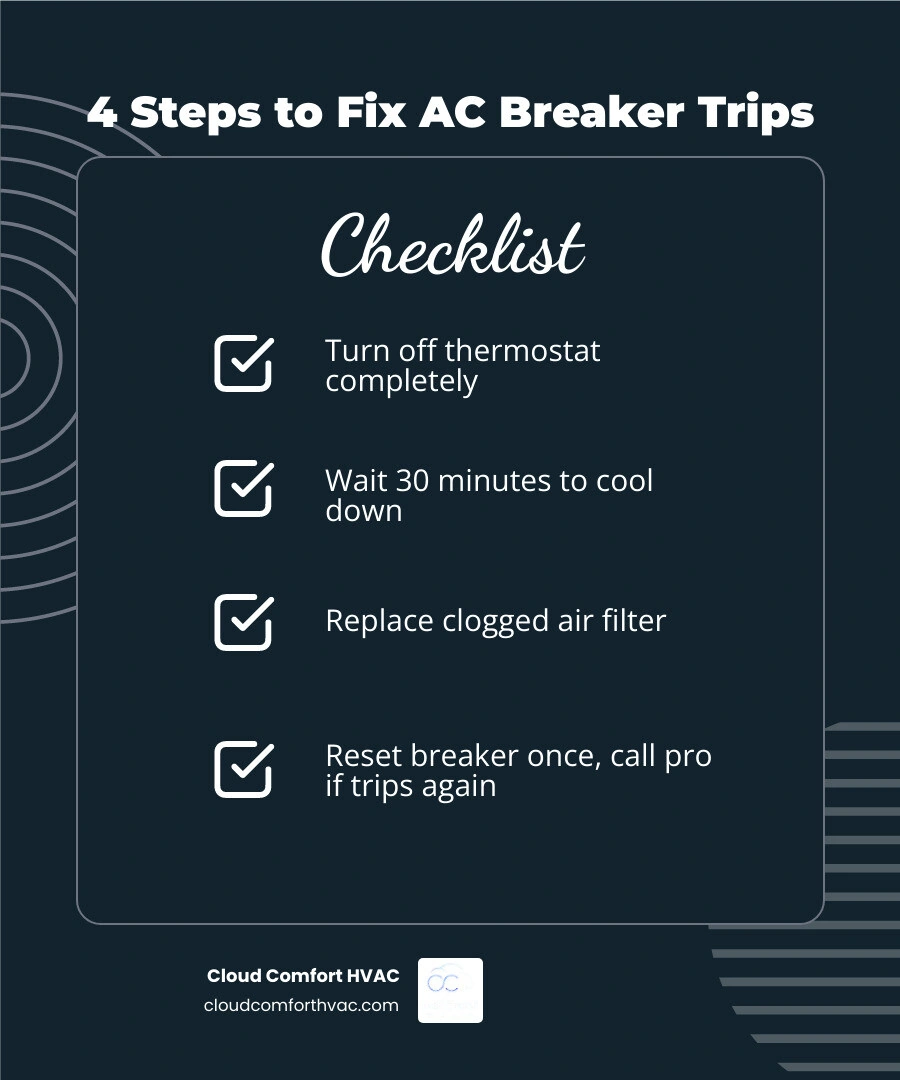
When your AC trips the circuit breaker, follow these steps:
- Turn off your thermostat completely before touching the breaker.
- Wait 30 minutes to let the system depressurize and cool down.
- Check your air filter — a clogged filter is the most common cause.
- Reset the breaker once by pushing it fully to OFF, then firmly back to ON.
- If it trips again immediately, stop resetting and call a licensed HVAC technician.
Southern California homes face unique pressure on their cooling systems. From scorching summer heat waves in Torrance to the marine-layer humidity along the Palos Verdes Peninsula, AC units here work harder — and longer — than in most parts of the country. That extra demand puts real stress on your electrical system. When the breaker trips the moment your AC kicks on, it's not just an inconvenience. It's your home's electrical system flagging a problem that deserves attention.
The good news? Some causes are simple and safe to address yourself. Others need a professional right away. This guide walks you through exactly how to tell the difference.
Circuit breaker tripping when ac turns on what to do in a socal home vocabulary:
Understanding Your AC Circuit Breaker and How It Works
Think of your circuit breaker as the safety bouncer of your home’s electrical system. Its primary job is to monitor the flow of electricity through your wiring. If the current (measured in amps) exceeds a safe level, the breaker shuts off the power instantly. This prevents the wires from overheating, melting their insulation, and potentially starting an electrical fire.

When it comes to central air conditioning systems, they don't run on standard household circuits. Your television, lamps, and phone chargers run on 120-volt, 15- or 20-amp single-pole breakers. Your central AC, however, is a heavy-duty appliance that requires a dedicated 240-volt circuit protected by a double-pole breaker (typically rated between 30 to 60 amps).
A dedicated circuit means no other appliances share that specific electrical pathway. This is crucial because your AC draws a substantial amount of electrical current, especially the moment the compressor kicks on.
There are three primary reasons a circuit breaker will trip:
- Overload: This occurs when the circuit is being asked to carry more electrical current than it is rated to handle. In HVAC systems, this usually happens slowly. The AC runs for a few minutes, struggles, draws slightly too much power as components overheat, and eventually trips the breaker.
- Short Circuit: This happens when a hot wire (carrying the current) directly touches a neutral wire or another hot wire. This bypasses the normal resistance of the appliance, causing an instantaneous, massive spike in electrical current. If your breaker trips the exact millisecond the AC turns on, a short circuit is a highly likely culprit.
- Ground Fault: Similar to a short circuit, a ground fault occurs when a hot wire comes into contact with a grounded component, such as the metal chassis of your outdoor condenser unit or a ground wire. Like a short, this causes an immediate surge in current that trips the breaker instantly to prevent electrical shocks.
Before you assume the worst, taking a step back to perform some basic checks can save you time and frustration. If you want to dive deeper into the basics of checking your system safely, read our guide on AC Troubleshooting Before Calling a Pro.
Circuit Breaker Tripping When AC Turns On: What to Do in a SoCal Home
When you are faced with a circuit breaker tripping when ac turns on what to do in a socal home depends heavily on whether the problem is mechanical or electrical. In many cases, mechanical strain on the air conditioner translates directly into electrical strain at your breaker panel.
When an AC component is forced to work harder due to lack of maintenance, it draws more electrical current to get the job done. Here are the most common culprits:
- Dirty Condenser Coils: Your outdoor unit contains coils that disperse the heat removed from inside your home. If these coils are covered in dirt, dust, or coastal grime, they cannot release heat efficiently. The compressor has to work twice as hard and run much longer to cool your home, driving up the amp draw until the breaker trips.
- Failing Capacitor: The capacitor acts like a temporary battery that gives your compressor and fan motors the high-voltage boost they need to start running. If the capacitor is weak or failing, the compressor will struggle to start, drawing massive amounts of "locked rotor" current trying to turn over, which instantly trips the breaker.
- Worn or Pitted Contactor: The contactor is an electrical switch in your outdoor unit that closes when the thermostat calls for cooling, sending power to the compressor and fan. Over time, the silver coating on the contactor contacts can wear down or "pit," creating electrical resistance and arcing. This resistance causes a drop in voltage and a corresponding spike in amperage.
- Condenser Fan Motor Failure: If the outdoor fan motor is seizing up or has shorted windings, it won't spin fast enough to cool the refrigerant. The system's pressure and temperature will skyrocket, forcing the compressor to draw excessive current.
If your system is shutting down frequently but not always tripping the breaker, you might be dealing with a related safety switch issue. Learn more about how to Fix AC That Keeps Shutting Off Unexpectedly to see if your system is short-cycling.
Common Causes of a Circuit Breaker Tripping When AC Turns On What to Do in a SoCal Home
In Southern California, our environment plays a massive role in how our HVAC systems behave. Local factors can turn a small maintenance oversight into a sudden electrical failure:
- Clogged Air Filters and Frozen Evaporator Coils: A dirty air filter blocks airflow across your indoor evaporator coil. Without warm air passing over it, the refrigerant gets too cold, and moisture on the coil freezes solid. A frozen coil chokes the system, forcing the compressor to run continuously under high stress until the circuit overloads.
- South-Facing, Unshaded Garages: In many SoCal suburbs, from Fullerton to Torrance, CA, main electrical panels are installed on the exterior of the house or inside unshaded, south-facing garages. During a July or August afternoon, these spaces can easily reach 110°F to 120°F. Circuit breakers are thermal-magnetic devices; high ambient heat naturally lowers their tripping threshold, meaning they may trip at lower-than-rated loads simply because the panel itself is baking.
- Coastal Humidity and Marine Layer Salinity: If you live in Palos Verdes Estates, Manhattan Beach, or Hermosa Beach, your outdoor condenser is constantly exposed to moisture and salt-laden air. This coastal environment accelerates the corrosion of electrical connections, contactors, and fan motor bearings, leading to increased electrical resistance and premature component failure.
Severe Electrical Issues and a Circuit Breaker Tripping When AC Turns On What to Do in a SoCal Home
While a dirty filter is an easy fix, some electrical issues are severe and pose immediate safety risks to your home:
- Grounded Compressor: This is the worst-case scenario for an air conditioner. A grounded compressor occurs when the electrical windings inside the motor break down and make direct contact with the metal walls of the compressor. This creates a direct path to the ground, causing a massive short circuit that trips the breaker instantly.
- Shorted Motor Windings: The motors inside your compressor and outdoor fan rely on tightly wound copper coils insulated by a thin varnish. If this varnish degrades due to overheating or age, the wires touch, shortening the electrical path and causing an immediate overcurrent trip.
- Loose or Damaged Wiring: Because of the constant vibration of the outdoor unit, electrical connections can vibrate loose over time. Loose wires create high resistance, which generates intense heat and can melt wire nuts or damage terminal blocks, leading to a short circuit.
If you suspect your compressor is on its last legs, read up on the Warning Signs Your AC Compressor is Failing to protect your system before a total breakdown occurs.
Safe Troubleshooting Steps for SoCal Homeowners
Before you reach for your phone to call in the pros, there are a few safe, basic troubleshooting steps you can take. However, it is vital to know your limits. You should never open the electrical panels of your AC unit or remove the "dead front" cover of your home’s main service panel. Leave all internal electrical diagnostics to a licensed professional.
| Action | Safe for Homeowners? | What to Look For / Do |
|---|---|---|
| Check Air Filter | Yes | Replace if grey, dusty, or clogged. |
| Clear Outdoor Unit | Yes | Maintain 2 feet of clearance around the condenser. |
| Thermostat Reset | Yes | Turn to OFF, wait 30 minutes, reset breaker, turn to COOL. |
| Inspect Electrical Panel | Yes (Visual Only) | Look for warm breaker face, burnt smells, or rust. |
| Test Capacitor | No | Requires discharging high voltage and using a multimeter. |
| Inspect Wiring | No | Involves exposing live 240V terminals. |
The Safe 30-Minute Reset Rule
If your breaker trips, do not immediately flip it back on. Doing so can cause severe damage to a struggling compressor. Instead, follow this controlled reset protocol:
- Turn Off the Thermostat: Go to your indoor thermostat and set the system to "OFF." This ensures that when you reset the breaker, the AC does not immediately try to start up under load.
- Inspect the Air Filter: Pull out your indoor air filter. If it is caked in dust, replace it immediately.
- Clear the Outdoor Condenser: Walk outside and check your outdoor unit. Ensure no dry brush, leaves, or backyard storage is blocking the airflow. You need at least two feet of clear space around the entire unit.
- Wait 30 Minutes: This is the most crucial step. If the compressor was running hot or the system pressures were highly imbalanced, this cooling-off period allows internal thermal overloads to reset and system pressures to equalize.
- Reset the Breaker: Go to your main electrical panel. Locate the double-pole breaker labeled "AC" or "HVAC." It will likely be sitting in the middle "tripped" position. Push it firmly to the OFF position until you hear a distinct click, then flip it firmly to the ON position.
- Turn the Thermostat Back On: Go back inside and set your thermostat to "COOL."
The Golden Rule of Electrical Safety: If the breaker trips again immediately or within a few minutes, do not reset it a second time. Repeatedly resetting a tripping breaker forces massive amounts of current through a faulty circuit, which can melt your home's wiring, destroy the compressor, or spark a house fire.
Frequently Asked Questions About AC Breaker Trips
Can hot Southern California weather cause my breaker to trip?
Yes, extreme heat can absolutely contribute to breaker trips in two distinct ways. First, when outdoor temperatures climb in areas like Rancho Palos Verdes or Anaheim, your AC has to run much longer cycles to keep your home cool. This extended operation causes components to run hot, increasing electrical resistance and current draw.
Second, if your main electrical service panel is installed outdoors in direct, baking sunlight, the internal temperature of the panel can exceed 120°F. Circuit breakers are designed to trip based on heat; when the ambient air inside the panel is already incredibly hot, the breaker will trip at a lower electrical current than it normally would.
How can I tell if the problem is the breaker itself or the AC unit?
The timing of the trip is your best diagnostic clue.
- Immediate Trip: If the breaker trips the exact millisecond the AC turns on, you are likely dealing with a direct short circuit, a grounded compressor, or a completely seized motor.
- Delayed Trip: If the AC runs for 5, 10, or 20 minutes before the breaker trips, it is usually a thermal overload issue. This points to dirty coils, a clogged filter, a weak capacitor, or an aging, weak circuit breaker that has degraded over time.
If your home in Manhattan Beach, CA has an older electrical panel (especially brands like Federal Pacific or Zinsco), the breaker itself may be weak, loose on the bus bar, or failing to trip safely. A licensed electrician can test the amp draw on the wire to see if the AC is actually drawing too much power, or if the breaker is simply tripping prematurely.
Is it safe to keep resetting my tripped AC breaker?
No, it is highly unsafe. A circuit breaker is a safety device designed to protect your home. Resetting it repeatedly when a fault is present is the equivalent of taking the battery out of a smoke detector because you don't want to hear the alarm.
If there is a short circuit or a grounded compressor in your Culver City home, forcing the breaker back on can cause severe electrical arcing, melt the insulation on your home's wiring, destroy expensive HVAC components, and create a genuine fire hazard. Reset it once using our safe protocol. If it trips again, keep it off and call for professional help.
Conclusion
Dealing with a circuit breaker tripping when ac turns on what to do in a socal home can be stressful, but understanding how your system works is the first step toward restoring comfort safely. While a simple air filter swap is a quick DIY fix, persistent breaker trips are a clear signal that your system is experiencing severe mechanical or electrical strain.
At Cloud Comfort HVAC, we provide expert, eco-friendly cooling solutions tailored specifically to the unique climate challenges of Southern California. Whether you are dealing with coastal humidity in Palos Verdes Estates, intense heat in Carson, CA, or older electrical panels in Torrance, our highly rated team is here to help. We stand behind our work with transparent pricing and strong Daikin warranties, including our 1-year Comfort Promise, ensuring your home stays cool, safe, and energy-efficient all year long.
Don't let a tripping breaker ruin your indoor comfort or put your home's safety at risk. Contact us today to schedule our professional Professional AC Repair Services and get your system running smoothly again!
Have an HVAC or plumbing question?
Our Torrance comfort experts are here to help — no pressure, just honest answers.
Ask an Expert