Why Your AC Works Fine in the Morning but Struggles in the Afternoon
July 28, 2026

Why Your AC Works Fine in the Morning but Struggles in the Afternoon
If you've ever wondered why does my AC work fine in the morning but struggle in the afternoon, you're not alone — and the answer is usually one of these common causes:
- Rising outdoor temperatures push your system past its designed cooling capacity
- Dirty air filters or blocked condenser coils restrict airflow, which is manageable in the morning but not under peak heat
- Low refrigerant levels limit cooling output when the system needs it most
- A failing capacitor may function in cool morning temperatures but give out under afternoon heat stress
- Solar heat gain and attic heat add a mounting thermal load throughout the day that your AC has to fight against
- Leaky or poorly insulated ductwork loses conditioned air into superheated attic spaces during peak hours
- An undersized or aging system simply runs out of capacity as the day gets hotter
In most cases, your AC isn't broken — it's either hitting the limits of what it was designed to handle, or a small underlying issue is being exposed by the heavier afternoon workload.
Here's the core reason this happens: In the morning, outdoor temperatures are lower, your home's walls and attic haven't absorbed much solar heat yet, and the cooling load is light. By mid-afternoon, outdoor temperatures peak, your home's structure radiates stored heat inward, and the demand on your system surges — often all at once. A system that was coasting along just fine at 9 AM is now being asked to run a marathon.
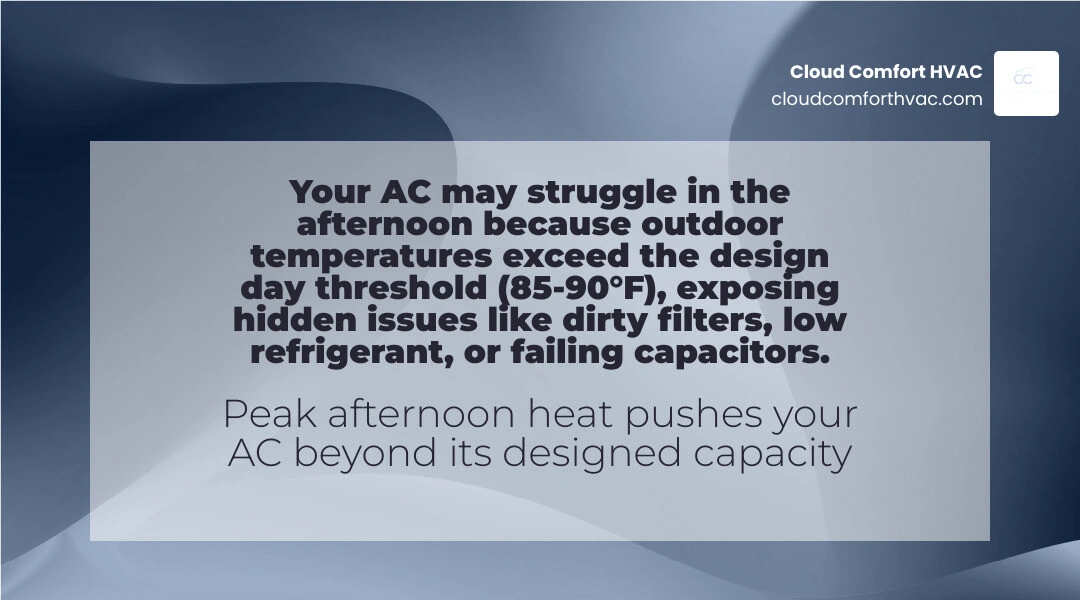
AC systems are actually designed for what engineers call a "design day" — typically around 85–90°F outside, with the goal of keeping your home around 75°F inside. When Southern California summers push temperatures into the high 90s or above 100°F, your system is operating beyond that design threshold. That's when hidden weaknesses show up.
I'm Isidro Davalos, and as an HVAC technician serving homeowners across the South Bay and greater Los Angeles area, I'll walk you through exactly how to diagnose what's going on with your system and what you can do about it.
Explore more about why does my ac work fine in the morning but struggle in the afternoon:
- ac troubleshooting before calling a pro
- ac not cooling but running what to check first in the south bay
- ac keeps turning on and off what is wrong
Why Does My AC Work Fine in the Morning but Struggle in the Afternoon?

To understand why your air conditioner seems to lose its mojo as the day goes on, we have to look at the relationship between outdoor temperatures, indoor heat accumulation, and the physical limits of air conditioning technology.
During the morning hours, your home is at its coolest. The outdoor air temperature is relatively low, and the sun hasn't had enough time to bake your roof and walls. Because of this, the temperature difference between the indoor air and the refrigerant inside your AC system is highly favorable. Heat transfer happens quickly and efficiently. Your system only needs to run short, easy cycles to maintain your target indoor temperature.
However, as the clock ticks past noon, several factors change simultaneously:
- The Thermal Mass Effect: Your home's construction materials — such as stucco, concrete, wood, drywall, and glass — act like a giant thermal battery. Throughout the morning, they absorb solar radiation. By the afternoon, this stored heat begins to radiate directly into your living spaces. This delayed heat release means your AC has to fight both the high outdoor air temperature and the heat radiating from your own walls and ceilings.
- The "Design Day" Threshold: Most residential air conditioners in Southern California are engineered to handle a specific "design day" temperature. This is typically set around 85°F to 90°F. When outdoor temperatures exceed this threshold — which is common during summer heatwaves in Torrance, Carson, or Buena Park — the system must run continuously just to prevent the indoor temperature from climbing.
- Elevated Condenser Temperatures: Your outdoor unit (the condenser) is responsible for releasing the heat it gathered from inside your home. If the outdoor air is 95°F, and the unit is sitting in direct, blazing afternoon sunlight, the air surrounding the condenser can easily exceed 110°F. It becomes incredibly difficult for the system to dump heat into air that is already scorching hot.
When these factors converge, any minor inefficiency in your system — such as a slightly dirty filter, a minor refrigerant leak, or a weak electrical component — is instantly exposed. To learn more about how local microclimates and daily weather cycles impact your home's comfort, check out our guide on How Weather in Torrance CA Affects Your HVAC System.
Common Mechanical Causes of Afternoon Cooling Failure
When an air conditioner performs beautifully in the morning but falls behind in the afternoon, it is frequently a sign of system strain or capacity loss rather than a complete mechanical breakdown. Under light morning loads, a compromised system can still manage to cool. But once the peak demand hits, the mechanical deficiency prevents the system from keeping pace with the rising heat.
If you are trying to determine whether your system is simply working hard on a hot day or if it is suffering from a mechanical failure, refer to this comparison table:
| Symptom | Normal Afternoon Behavior | Potential Mechanical Failure |
|---|---|---|
| Indoor Temperature | Rises 2–3°F above your thermostat setting during the hottest hours, then recovers quickly after sunset. | Climbs 5–10°F or more above your setpoint, and the home fails to cool down even late into the evening. |
| System Runtime | Runs long, continuous cycles during the peak heat of the day (2 PM to 6 PM). | Runs constantly without ever shutting off, or shuts down unexpectedly and blows warm air. |
| Airflow Strength | Consistent, strong airflow from all supply vents, even if the air feels slightly less icy than in the morning. | Weak, barely noticeable airflow, or the air coming out of the registers feels warm or lukewarm. |
| System Noises | Standard, steady hum from the outdoor compressor and indoor blower motor. | Loud clicking, grinding, or high-pitched whistling sounds coming from either unit. |
| Physical Signs | Normal condensation dripping from the designated outdoor drain line. | Ice buildup on the outdoor copper lines, water pooling around the indoor furnace, or frozen coils. |
If your system's behavior aligns with the "Mechanical Failure" column, you likely need a professional diagnostic check. We recommend scheduling an inspection with an expert technician to perform an AC Repair Torrance CA before a minor issue turns into a total system failure.
Dirty Air Filters and Blocked Condenser Coils
The two most common, yet easily preventable, causes of afternoon cooling struggles are restricted airflow and poor heat transfer. Both of these issues stem from accumulated dirt and debris.
Your indoor air filter is the gatekeeper of your system's airflow. When it becomes clogged with dust, pet dander, and hair, the blower motor has to work twice as hard to pull air through the system. During the morning, the system can still pull enough air to satisfy the low cooling demand. However, in the afternoon, the system requires maximum airflow to distribute cool air effectively. A dirty filter chokes the system, reducing its capacity and occasionally causing it to overheat and shut down entirely.
On the outside of your home, the condenser unit is wrapped in thin aluminum fins called condenser coils. The job of these coils is to release the heat extracted from your indoor air. Over time, outdoor coils collect dirt, grass clippings, leaves, and spiderwebs. This layer of grime acts like an insulating blanket, trapping heat inside the system.
When afternoon outdoor temperatures spike, a dirty condenser coil cannot release heat fast enough. The compressor's internal temperature skyrockets, often triggering a safety switch that shuts the compressor down to prevent permanent damage. If your system is running but not cooling, you can learn how to check these components yourself by reading our guide on AC Troubleshooting Before Calling a Pro.
Low Refrigerant Levels and Frozen Evaporator Coils
An air conditioner does not consume or "burn" refrigerant. It circulates the same charge of refrigerant continuously in a closed loop. If your system is low on refrigerant, it means there is a leak somewhere in the copper lines or coils.
Low refrigerant levels directly cause your indoor evaporator coil to drop below freezing temperatures. When the warm, humid indoor air passes over a freezing coil, the moisture in the air condenses and instantly freezes onto the coil's metal fins.

This ice buildup creates a compounding problem:
- A thin layer of ice forms on the evaporator coil.
- The ice insulates the coil, preventing it from absorbing heat from your home's air.
- Airflow is physically blocked by the growing block of ice.
- The system runs continuously because the thermostat is never satisfied, causing even more ice to accumulate.
This explains why your AC might work fine in the morning but fail by 2 PM. During the early hours, the ice is just beginning to form, and some airflow can still squeeze past. But after hours of continuous afternoon operation, the coil becomes a solid block of ice, completely blocking airflow and leaving you with warm air blowing from your vents. If you suspect this is happening to your system, check out our article on Why Is AC Freezing Up in the Summer Heat to learn how to safely thaw it out.
Failing Capacitors and Electrical Components
Your outdoor AC unit relies on a small, cylindrical device called a capacitor to store and release electrical energy. The capacitor acts like a heavy-duty battery that provides the high-voltage boost needed to start and run the compressor and condenser fan motor.
Capacitors are highly sensitive to extreme heat. While a high-quality capacitor can last up to 20 years under ideal conditions, exposure to direct afternoon sun and high electrical loads can cause them to degrade rapidly.
When a capacitor begins to fail, it becomes "weak." In the relatively cool morning hours, a weak capacitor might still have just enough electrical charge to start the compressor. But as the afternoon heat builds, the compressor faces much higher starting resistance (head pressure). The weak capacitor fails to deliver the necessary power, causing the compressor to hum loudly, overheat, and shut down without starting.
If this happens, your outdoor fan may still spin, but the compressor won't run, resulting in your system blowing lukewarm indoor air. For actionable steps on dealing with this issue, read our guide on What to Do When AC Is Blowing Warm Air.
Environmental and Structural Factors in Southern California
In Southern California, our local geography and home construction styles play a massive role in how our air conditioners perform. From the coastal marine layer in Manhattan Beach and Hermosa Beach to the intense, dry inland heat of Anaheim and Cypress, the climate directly dictates the load placed on your HVAC system.
Many homes in our service area — especially older homes built in the mid-to-late 20th century — were not designed with modern energy efficiency standards in mind. These homes often feature:
- Minimal or degraded attic insulation
- Single-pane windows that allow massive solar heat gain
- Uninsulated ductwork routed through unconditioned attic spaces
When summer heatwaves strike, these structural vulnerabilities are magnified, forcing your AC to work overtime to keep your family comfortable. If you want to understand how our unique local weather patterns put extra strain on your cooling system, read our detailed breakdown on Why Torrance AC Struggles July Heatwaves.
How Attic Heat and Duct Leakage Worsen Afternoon Struggles
If your home's ductwork is routed through your attic, it is subjected to some of the harshest conditions imaginable. On a sunny, 90°F afternoon, attic temperatures can easily climb past 130°F.
This extreme heat affects your AC system in two devastating ways:
- Attic Heat Absorption: Even if your ductwork is insulated, the extreme temperature difference between the 130°F attic air and the 55°F conditioned air inside the ducts causes heat to transfer through the duct walls. By the time the cooled air travels from your indoor unit to your bedrooms, it has warmed up significantly. The air coming out of your vents feels weak and lukewarm, even though your AC is technically running perfectly.
- Duct Leakage: The average residential duct system loses up to 20% of its conditioned air through small gaps, cracks, and loose connections. When your ducts leak inside a superheated attic, you are literally paying to cool your attic space. Worse yet, when the system turns off, the high static pressure can draw hot, dusty attic air directly into your living spaces, compounding the afternoon heat load.
If your system is running constantly but your rooms remain warm, you can learn how to perform a preliminary inspection by reading AC Not Cooling But Running What to Check First in the South Bay.
The Impact of High Humidity on Cooling Capacity
To keep your home comfortable, your air conditioner must perform two distinct tasks: it must lower the air temperature (sensible cooling) and remove excess moisture from the air (latent cooling).
When indoor humidity levels rise into the mid-50% range or higher, the air feels heavy, sticky, and significantly warmer than the actual temperature reading on your thermostat. This is especially true in coastal communities like Redondo Beach, Palos Verdes Estates, and Hermosa Beach, where damp ocean air regularly rolls in.
When your AC has to deal with high humidity, it must dedicate a massive portion of its cooling capacity just to condensing water vapor out of the air. This means less energy is available to actually lower the room temperature. In the afternoon, when both the outdoor temperature and humidity peak, an AC system that lacks proper moisture-removal capacity will struggle to keep the home feeling dry and cool, leaving you feeling sticky and uncomfortable even if the system runs continuously.
DIY Troubleshooting and Prevention Strategies
Before you pick up the phone to call for professional service, there are several simple, safe DIY checks you can perform to see if you can resolve your afternoon cooling issues yourself. Taking a few minutes to inspect your system can save you time and help you maintain peak efficiency all summer long. For a comprehensive look at preparing your home for the warm season, read our AC Tune Up Guide Coastal Socal 2026.
Simple Checks for why does my ac work fine in the morning but struggle in the afternoon
If your system is falling behind as the day gets hotter, walk through this quick troubleshooting checklist:
- Check the Thermostat Settings: Ensure your thermostat is set to "Cool" and the fan is set to "Auto" rather than "On." When the fan is set to "On," it runs continuously, even when the AC isn't actively cooling. This can blow the moisture off your evaporator coil back into your home, raising indoor humidity levels in the afternoon.
- Inspect the Air Filter: Pull out your return air filter and hold it up to a light source. If you cannot see light passing through the fibers, replace it immediately. We recommend changing standard 1-inch filters every 1 to 3 months, especially during heavy summer use.
- Verify Vent Clearance: Walk through your home and ensure that all supply registers and return air grilles are completely open and unblocked by furniture, drapes, or rugs. Closing vents to "redirect" air actually raises static pressure, reducing overall system efficiency.
- Clear the Outdoor Unit: Ensure there is at least a two-foot clearance around your outdoor condenser unit. Trim back any overgrown bushes, weeds, or vines. If the condenser coils look dusty or dirty, turn off the power at the outdoor disconnect box and gently rinse the coils with a garden hose (never use a pressure washer, as it can bend the delicate aluminum fins).
- Reduce Solar Heat Gain: Close your blinds, curtains, or drapes on all south- and west-facing windows starting at noon. This simple step blocks direct solar radiation, drastically reducing the thermal load your AC has to fight in the afternoon.
Preventative Maintenance for why does my ac work fine in the morning but struggle in the afternoon
The single best way to prevent your air conditioner from struggling during summer heatwaves is to invest in regular, professional preventative maintenance. Routine maintenance catches minor issues — like a slightly weak capacitor, a tiny refrigerant leak, or dirty coils — before they escalate into an afternoon breakdown.
During a professional tune-up, a certified technician will thoroughly clean both the indoor and outdoor coils, measure refrigerant pressures, test electrical components, and ensure your system is operating at its maximum manufacturer-rated efficiency.
Whether you live near the coast and need an AC Service Hermosa Beach CA or reside further inland and require an AC Tune Up Cypress CA, regular maintenance is key to keeping your home comfortable when the heat peaks.
Frequently Asked Questions about Afternoon AC Struggles
Navigating air conditioning issues can be confusing. Here are clear, straightforward answers to some of the most common questions we receive from homeowners experiencing afternoon cooling struggles.
Is it normal for my house to be warmer in the afternoon even with the AC running?
Yes, to a certain degree. On exceptionally hot summer days when outdoor temperatures exceed 95°F, it is completely normal for your indoor temperature to drift 3 to 5 degrees above your thermostat setpoint during the hottest part of the afternoon (typically between 2 PM and 6 PM).
Your system is operating at its maximum physical capacity, and as long as the indoor temperature recovers quickly once the sun goes down, your system is likely performing as designed. However, if the temperature climbs 8 to 10+ degrees above your setpoint, or if the system fails to cool the house back down after sunset, it indicates an underlying mechanical issue or a severe capacity loss.
Should my AC run constantly during the hottest part of the day?
Yes. When outdoor temperatures peak, running continuously is actually the most energy-efficient way for your air conditioner to operate. Modern systems are designed to run long, steady cycles to maintain a consistent indoor temperature and continuously remove humidity from the air.
Frequent starting and stopping (short-cycling) puts massive wear and tear on the compressor and consumes significantly more electricity. However, if your system runs constantly and the indoor temperature continues to rise throughout the afternoon, it is a sign that the heat load entering your home is outpacing your system's cooling capacity.
When should I call a professional HVAC technician?
You should call a professional technician immediately if you notice any of the following warning signs:
- The system is running constantly, but the air blowing from your vents is warm or lukewarm.
- You see physical ice forming on the outdoor refrigerant lines or the indoor evaporator coil.
- You hear strange grinding, squealing, or loud clicking noises coming from either the indoor or outdoor unit.
- You smell a burning, electrical, or musty odor when the system turns on.
- The system repeatedly trips your home's circuit breaker or shuts down unexpectedly.
If you experience any of these issues during a scorching summer afternoon, don't sweat it out. Contact us for fast, reliable 24 Hour AC Repair La Palma CA to restore your home's comfort in no time.
Conclusion
When your air conditioner struggles to keep you cool in the afternoon, it is a clear sign that the system is under extreme strain. Whether the root cause is a simple airflow restriction like a dirty filter, an environmental challenge like intense solar heat gain, or a mechanical issue like a failing capacitor or low refrigerant, ignoring the warning signs can lead to a costly, total system breakdown when you need cooling the most.
At Cloud Comfort HVAC, we are dedicated to keeping Southern California families comfortable all year round. Serving communities from Rancho Palos Verdes and Manhattan Beach to Torrance and Carson, we provide eco-friendly, energy-efficient solutions tailored to your home's unique needs. With our transparent pricing, high Google rating, and exceptional warranties, you can trust our team to deliver fast, reliable service every time.
If your air conditioner is losing the battle against the afternoon heat, don't wait for it to fail completely. Contact us today to schedule a professional AC Repair and enjoy reliable, ice-cold comfort all summer long.
Have an HVAC or plumbing question?
Our Torrance comfort experts are here to help — no pressure, just honest answers.
Ask an Expert