How a Heat Pump Can Replace Both Your Furnace and AC in a Southern California Home: 5 Essential Steps
July 11, 2026

Why Southern California Homeowners Are Replacing Their Furnace and AC With One System
Understanding how a heat pump can replace both your furnace and AC in a Southern California home starts with a simple idea: a heat pump is one piece of equipment that heats and cools your home by moving heat rather than generating it.
Here is a quick answer for homeowners ready to make the switch:
How a Heat Pump Replaces Both Your Furnace and AC in a Southern California Home:
- Cooling mode - The heat pump works like a standard AC, pulling heat from inside your home and releasing it outdoors
- Heating mode - The system reverses direction, extracting heat from outdoor air and moving it inside — even on cool winter nights
- One system, one installation - A single ducted heat pump connects to your existing ductwork, replacing both units at once
- SoCal climate advantage - Southern California winters rarely drop below 40°F in coastal and mid-basin areas, which is the sweet spot for heat pump efficiency
- Energy efficiency gain - Heat pumps can reach a Coefficient of Performance (COP) of 3.0–4.5 in mild climates, meaning every unit of electricity moves 3 to 4.5 units of heat — far beyond what a gas furnace can achieve
For most homeowners in Torrance, Manhattan Beach, Rancho Palos Verdes, and surrounding South Bay communities, an aging furnace and AC are two separate systems approaching the end of their lives at the same time. Replacing both with a single heat pump simplifies your home's HVAC, cuts energy use, and positions your home for California's ongoing shift away from gas appliances.
According to the U.S. Department of Energy, heat pumps can reduce electricity use for heating by as much as 75% compared to electric furnaces — and they can reach efficiencies that simply are not possible with any combustion-based system. In 2024, heat pumps outsold traditional gas furnaces in the U.S. for the first time, with more than 5 million units sold.
The sections below walk you through the full conversion process, from evaluating your ductwork and electrical panel to choosing the right system for your specific climate zone and maximizing available rebates.
Understanding How a Heat Pump Can Replace Both Your Furnace and AC in a Southern California Home
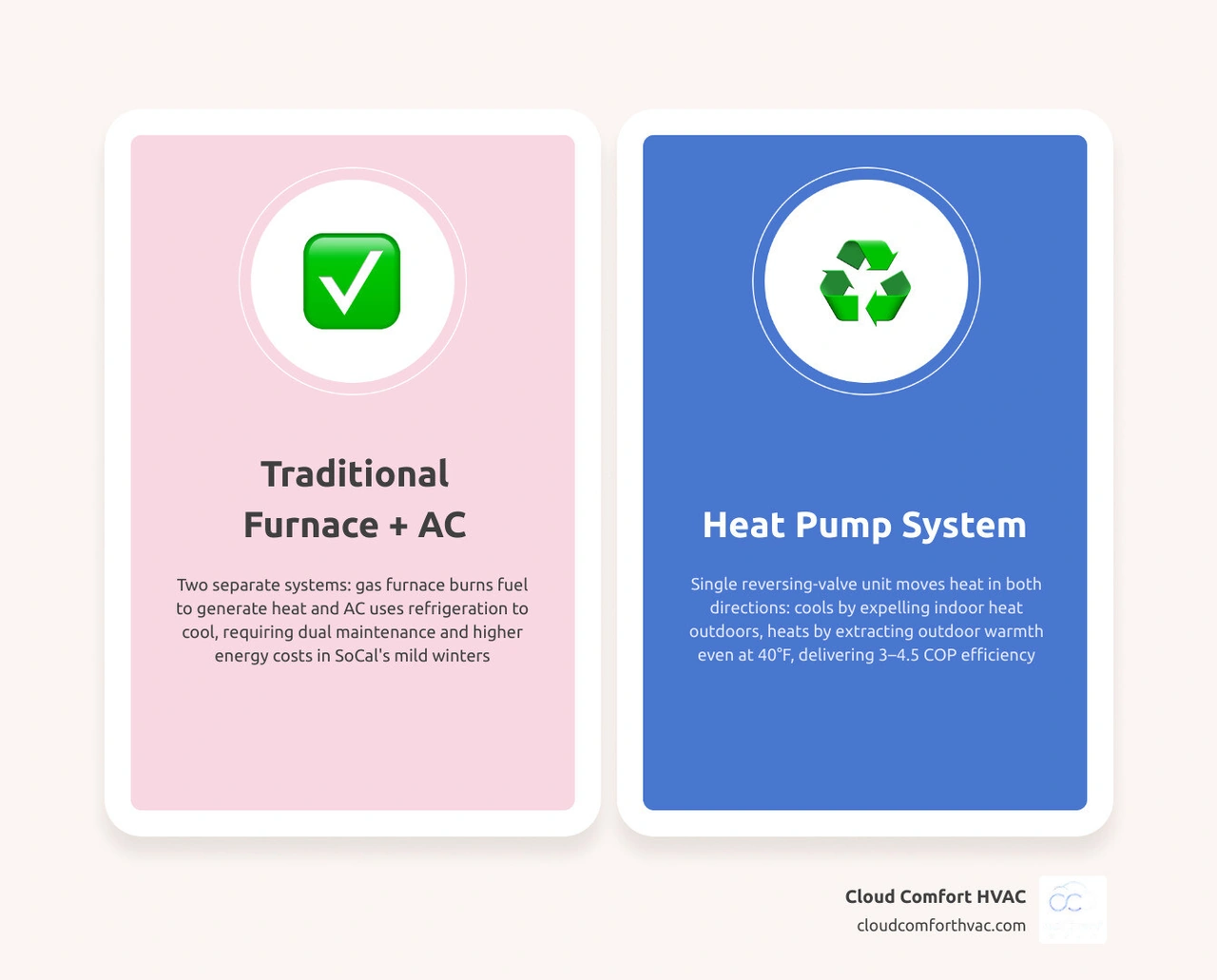
To understand how a single system can manage both July's heatwaves and January's chilly ocean breezes, it helps to look at the mechanics. A traditional HVAC setup relies on two entirely different technologies: an air conditioner that uses a refrigeration cycle to cool your home, and a gas or electric furnace that burns fuel or heats coils to create warmth.
A heat pump simplifies this by consolidating everything into one elegant system. Mechanically, the outdoor unit of a heat pump is nearly identical to a standard central Air Conditioning unit. It contains a compressor, condenser coils, and a fan. However, it features one critical component that a standard AC lacks: a reversing valve.
This reversing valve allows the system to change the direction of the refrigerant flow. In the summer, the heat pump extracts thermal energy from your indoor air and transfers it outside, leaving your home cool and dry. In the winter, the valve flips, and the system extracts ambient heat from the outdoor air—yes, even when it feels chilly to you—and pumps it indoors.
Because it moves existing heat rather than burning fossil fuels to create it, the system achieves remarkable efficiency. You can read more about these mechanisms in our guide on the Advantages of Heat Pumps for Energy Efficiency.
To put this efficiency into perspective, let's look at how heat pumps compare to traditional heating systems:
| System Type | Heating Efficiency Metric | Average Coefficient of Performance (COP) | Southern California Suitability |
|---|---|---|---|
| Standard Gas Furnace | 80% – 98.7% AFUE | 0.80 – 0.98 | Moderate (Overkill for mild winters, burning gas indoor) |
| Electric Resistance Furnace | 100% AFUE | 1.00 | Poor (Extremely high electric bills) |
| Modern Variable-Speed Heat Pump | 10.0+ HSPF2 / 300%+ | 3.00 – 4.50 | Excellent (Perfect for coastal and mid-basin areas) |
While even the most advanced gas furnace tops out at around 98.7% efficiency (meaning some fuel is always lost as waste gas), a heat pump operating in our mild climate routinely achieves 300% to 400% efficiency. That means for every unit of electricity the system consumes, it delivers three to four times that amount in heating energy.
Step-by-Step Process for Converting Your Gas Furnace and AC to a Heat Pump
Transitioning to a fully electric heat pump system is a highly rewarding home upgrade, but it requires careful planning to ensure long-term performance. We do not simply swap the boxes; we look at your home as a complete thermal system.
The first step in any professional conversion is a comprehensive home assessment. This includes performing a Manual J load calculation. This calculation determines the exact heating and cooling capacity your home needs based on square footage, window placement, insulation levels, and local climate data. Sizing a heat pump correctly is critical: an oversized system will cycle on and off too frequently, while an undersized system will struggle during peak summer heatwaves.
Once the system is sized, the conversion process involves:
- Decommissioning and safely capping the existing gas line feeding your old furnace.
- Removing the old indoor furnace and outdoor AC condenser.
- Evaluating the electrical panel to ensure it can support the new heat pump.
- Installing the new indoor air handler and outdoor heat pump unit.
- Upgrading refrigerant lines and installing proper condensate drainage.
For a deeper look at what to expect during the physical installation, check out our Heat Pump Installation Complete Guide, which outlines the technical steps in detail, or explore our general Heating services to see how we approach home comfort.
Step 1: Evaluating Your Existing Ductwork and Electrical Capacity
Before we install a new heat pump, we must look at two critical pieces of infrastructure: your air ducts and your electrical panel.
Because heat pumps deliver a steadier, more continuous flow of air at a slightly lower temperature than a roaring gas furnace, they require properly sized, well-sealed ductwork. If your home has old, leaky ducts, you could lose up to 30% of your conditioned air to the attic or crawlspace. During our evaluation, we test duct integrity and, if necessary, recommend sealing or minor modifications to maximize airflow.
If your home’s ductwork is beyond repair, or if you live in a classic home in Torrance or Palos Verdes Estates that completely lacks ductwork, we often recommend looking into Ductless mini-split heat pumps. These systems bypass ducts entirely, using individual wall-mounted or ceiling-recessed heads to zone your comfort.
On the electrical side, a heat pump requires a dedicated 240V circuit. Many older homes in the South Bay still run on legacy 100-amp electrical panels. While a 100-amp panel can occasionally handle a smaller 2-ton or 3-ton heat pump, larger homes or those with multiple electric appliances may require an upgrade to a 200-amp panel to safely manage the new load.
Step 2: Choosing the Right Heat Pump for Your Southern California Climate Zone
Not all heat pumps are created equal, and the right system for your home depends heavily on your specific microclimate.
If you live in Manhattan Beach, CA, you deal with a heavy marine layer, mild summers, and damp, cool winters. Your heating and cooling loads are relatively balanced and moderate. A standard, high-efficiency single-stage or two-stage heat pump will keep you incredibly comfortable year-round.
However, if you live further inland in Carson or Culver City, where summer temperatures regularly spike into the 90s, you need a system that can handle intense cooling demands. For these areas, we highly recommend variable-speed inverter heat pumps. Unlike traditional systems that run at either 0% or 100% capacity, inverter-driven compressors modulate their speed in tiny increments. They run continuously at a low, ultra-efficient whisper, maintaining a rock-steady indoor temperature and removing excess humidity far better than a standard AC.
To learn more about how these modern systems elevate home comfort, explore the Top 5 Reasons to Buy a Heat Pump System.
Key Considerations for Homeowners in Torrance, Manhattan Beach, and Rancho Palos Verdes
Living in the South Bay and peninsula areas means navigating unique local rules, microclimates, and home styles. Whether you are dealing with the salty, corrosive air of coastal Manhattan Beach or the strict zoning requirements of Rancho Palos Verdes, local expertise is essential.
Every heat pump installation in California must comply with Title 24 building energy efficiency standards. This means we must pull municipal permits and arrange for independent Home Energy Rating System (HERS) testing after the installation. A certified HERS rater will visit your home to verify that duct leakage is within state-approved limits and that the system's refrigerant charge is perfectly balanced.
Choosing a system that meets these rigorous standards ensures you are investing in Eco-Friendly Heating that reduces your carbon footprint. In fact, air-source heat pumps trim household carbon dioxide emissions by about 40% compared to gas furnaces, making them a cornerstone of California's clean-energy future.
How a heat pump can replace both your furnace and ac in a southern california home during a remodel
If you are planning a major home renovation in Palos Verdes Estates, CA, or Torrance, it is the absolute perfect time to plan a heat pump conversion. Remodeling projects often require opening up walls, updating electrical wiring, or reconfiguring layouts—making the transition to a heat pump incredibly seamless.
Consolidating your heating and cooling into a single outdoor footprint frees up valuable real estate. Removing a bulky indoor furnace from a hallway closet or utility room can give you extra storage space or allow you to expand a bathroom.
Furthermore, if you are looking to fully electrify your home during the remodel, you can pair your space-conditioning upgrade with an energy-efficient heat pump Water Heater. This allows you to completely sever your reliance on gas, simplifying your utility bills and future-proofing your home against upcoming state restrictions on gas appliances.
How a heat pump can replace both your furnace and ac in a southern california home to maximize rebate eligibility
In June 2026, the financial incentives for upgrading to a heat pump are incredibly compelling. Because California is actively pushing to reduce greenhouse gas emissions, local utility providers and state programs have stepped up with robust rebate opportunities.
Depending on your specific zip code, you can stack multiple incentives to significantly offset your installation costs:
- LADWP Territory: Homeowners in Los Angeles Department of Water and Power territory can take advantage of substantial heat pump rebates, offering up to $1,250 per ton for ducted systems and even more for ductless configurations.
- Southern California Edison (SCE): SCE offers clean energy incentives ranging from $300 to $1,200 for qualifying heat pump installations.
- TECH Clean California: This state initiative provides direct-to-contractor incentives that we pass directly to you, making premium variable-speed systems much more accessible.
- SoCalGas Furnace-Removal Incentives: You may even qualify for small incentives simply for decommissioning and removing your old, inefficient gas furnace.
During our initial consultation, we will assess your home’s utility providers in Carson, Torrance, or Manhattan Beach to build a customized rebate stack, ensuring you do not leave any money on the table.
Long-Term Maintenance and Performance of Your New System
A high-quality heat pump is a long-term investment in your home. With professional installation and routine care, you can expect a modern heat pump to provide reliable comfort for approximately 15 years.
Because a heat pump works hard all year—cooling you in the summer and warming you in the winter—it experiences more consistent wear and tear than a dedicated furnace that sits idle for nine months of the year. This makes regular preventative care essential.
To make this easy, we recommend enrolling in a professional Maintenance Plan. Regular check-ups keep your system operating at peak efficiency, protect your manufacturer warranty, and catch minor wear before it turns into an unexpected breakdown. You can read more about what is included in these seasonal visits in our guide on System Maintenance.
Keeping Your System Running Efficiently Year-Round
While we handle the heavy lifting during our preventative visits, there are a few simple tasks you can do to keep your system running beautifully:
- Change your air filters regularly: Check your filters every 1 to 3 months. A clogged filter restricts airflow, forcing your heat pump to work harder and consume more electricity.
- Keep the outdoor unit clear: Ensure that leaves, dirt, and garden shrubs do not block the airflow around your outdoor condenser. The system needs room to breathe to transfer heat effectively.
- Schedule seasonal tune-ups: Having a professional inspect the electrical connections, clean the coils, and verify refrigerant levels before the summer heat and winter cool sets in is the best way to avoid issues.
If you want to ensure your system is fully optimized, consider scheduling an HVAC Systems Complete Tune Up. And if you ever run into an issue, our local technicians are always ready to help—check out our Heat Pump Repair Torrance CA Guide for troubleshooting tips and expert repair solutions.
Frequently Asked Questions about Heat Pump Conversions in Southern California
Can a heat pump handle the hot summers in the Inland areas and cool nights in coastal areas?
Absolutely. Modern heat pumps are highly capable of handling both extremes. In inland areas like Carson or parts of Culver City, CA, where summer afternoons can be hot, a properly sized variable-speed heat pump cools just as effectively as a traditional air conditioner. In fact, because it runs continuously at lower speeds, it does a superior job of removing indoor humidity. On the flip side, when the damp coastal marine layer rolls into Manhattan Beach or Rancho Palos Verdes at night, the heat pump easily extracts enough ambient warmth from the outdoor air to keep your home cozy without needing a backup furnace.
Do I need to completely remove my gas line when switching to a heat pump?
No, you do not have to completely remove your gas service. When we convert your heating system, we simply disconnect, cap, and seal the gas line that directly fed your old furnace. If you still have a gas stove, a gas clothes dryer, or a gas water heater, those appliances will continue to work perfectly.
How long does the actual installation process take for a full conversion?
A standard conversion from a gas furnace and AC to a ducted heat pump typically takes 1 to 2 days of on-site work. This timeline includes removing the old equipment, modifying duct connections, running new 240V electrical lines, mounting the new indoor air handler and outdoor unit, and thoroughly testing the system. Once the installation is complete, we will schedule the city inspection and the independent HERS duct-leakage testing, which is usually completed within 1 to 2 weeks.
Conclusion
Transitioning to a heat pump is one of the smartest, most energy-efficient upgrades you can make for your Southern California home. By replacing two aging, single-purpose units with one advanced, eco-friendly system, you will enjoy whisper-quiet comfort, lower monthly energy bills, and peace of mind knowing your home is prepared for California’s clean-energy future.
At Cloud Comfort HVAC, we are proud to serve our neighbors in Rancho Palos Verdes, Manhattan Beach, Culver City, Torrance, Palos Verdes Estates, and Carson. Our team brings technical expertise, transparent pricing, and a commitment to customer satisfaction to every job. As a proud installer of premium Daikin systems, we back our work with strong warranties and our signature 1-year Comfort Promise.
Ready to simplify your home comfort? Schedule your heat pump installation with Cloud Comfort HVAC today, and let us help you design the perfect year-round comfort solution for your home.
Have an HVAC or plumbing question?
Our Torrance comfort experts are here to help — no pressure, just honest answers.
Ask an Expert