What Causes Gas Line Failures In Coastal Southern California: 5 Critical Risks
June 29, 2026

Why Gas Line Failures Happen More Often on the Southern California Coast
What causes gas line failures in a coastal Southern California environment is a question every homeowner near the water should understand — because the risks here are very real and surprisingly varied.
Here are the main causes:
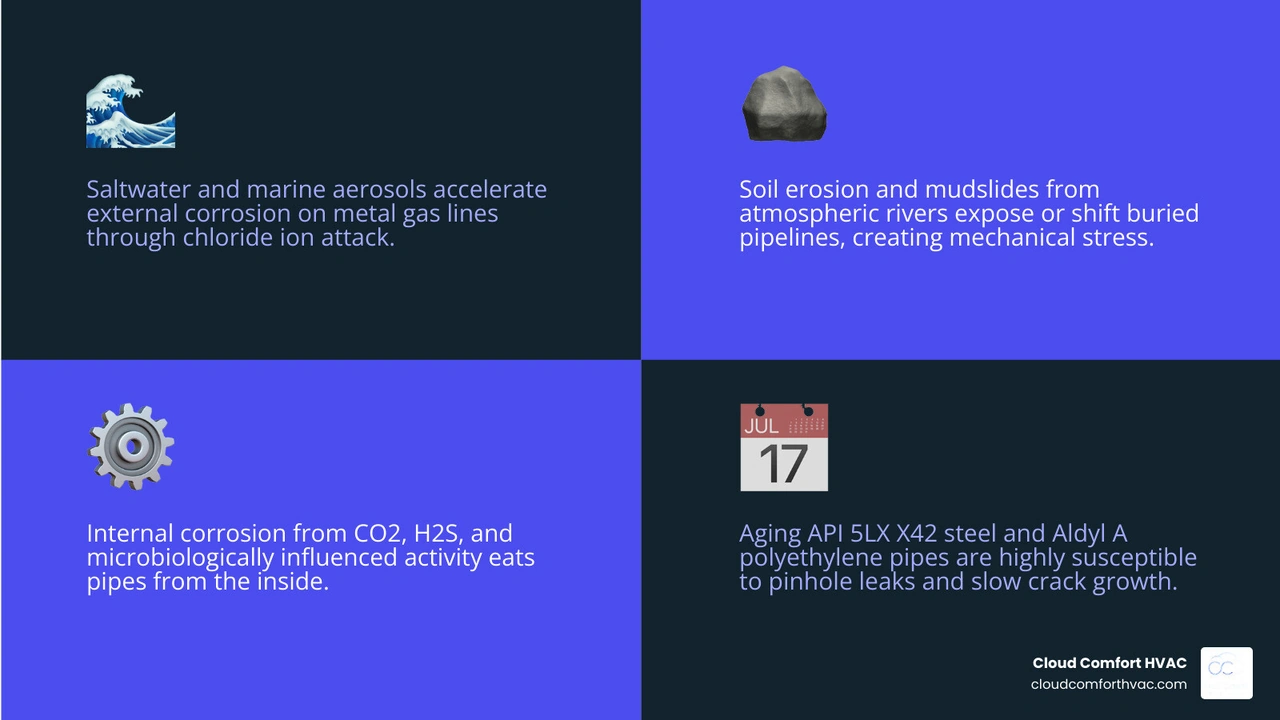
- Saltwater corrosion - Marine air and moisture drive chloride-based corrosion on metal pipes
- Soil movement and erosion - Mudslides, atmospheric rivers, and storm erosion shift or expose buried lines
- Internal corrosion - CO2, H2S, oxygen ingress, and microbial activity eat pipes from the inside
- Aging materials - Decades-old steel pipe (like API 5LX X42) and early polyethylene lines degrade over time
- Seismic and geologic stress - Ground movement puts mechanical strain on welds and joints
- Intermittent operation - Lines left idle collect stagnant water, accelerating localized pitting
- Anchor strikes and physical damage - Offshore lines face mechanical threats from boat anchors and shifting seafloor
The Southern California coast is one of the most demanding environments for buried pipelines in the country. Salt air, unstable hillside soils, aging infrastructure, and extreme weather events like tropical storms all work together to stress gas lines in ways that inland systems rarely face. Real incidents — from a pinhole leak at Aliso Canyon's Ward 3A well line to major ruptures during Tropical Storm Hilary — show just how many different failure pathways exist in this region.
This guide breaks down each cause clearly so you know what to watch for at home.
Understanding What Causes Gas Line Failures in a Coastal Southern California Environment

To understand why gas lines fail along our beautiful coast, we have to look at the unique combination of geology, weather, and chemistry at play. Coastal Southern California features a highly corrosive marine atmosphere, active seismic zones, and steep, unstable terrain that is increasingly subjected to extreme weather.
When we evaluate what causes gas line failures in a coastal Southern California environment, we must look at both external forces—like shifting soils and salty air—and internal forces, such as chemical reactions and microbial growth inside the pipes.
Environmental Factors: What Causes Gas Line Failures in a Coastal Southern California Environment?
Living near the ocean means dealing with salt. Marine aerosols carry highly corrosive chloride ions inland, settling on exposed metal surfaces and penetrating the soil. This elevated soil salinity, combined with high coastal humidity, creates a perfect battery for galvanic and atmospheric corrosion.
But the soil itself is also a major hazard. Southern California’s coastal hillsides are prone to severe landslide hazards. When heavy rains hit, the ground literally moves under our feet—and under our pipelines.
In recent years, we have seen this play out on a massive scale:
- The L-406 Crimea Street Incident (March 2024): An atmospheric river dumped over 13 inches of rain on Southern California—more than 400% of the normal precipitation for February. This saturated the foothill soils, triggering a massive mudslide. The resulting soil movement subjected a 22-inch steel transmission pipeline to extreme axial loading, causing a horizontal separation at a coated girth weld. The repair and property damage costs topped $5.4 million.
- Tropical Storm Hilary (August 2023): This historic storm brought torrential rains that washed away seven feet of landscape erosion in a local wash, exposing and snapping a 6-inch high-pressure gas main originally installed in 1964. The damage exceeded $3.6 million, and the line had to be reburied much deeper (15 to 20 feet below grade) to prevent future washouts.
These severe weather events show that physical soil movement can instantly snap even heavy-duty steel utility lines. If you suspect your property has experienced soil shifting or you smell gas after a heavy storm, it is critical to seek professional Gas Leak Repair Torrance CA or immediate Gas Leak Repair Manhattan Beach CA to ensure your home's connection lines remain intact.
Operational Risks: What Causes Gas Line Failures in a Coastal Southern California Environment?
While the environment attacks pipelines from the outside, operational conditions can destroy them from the inside. Internal corrosion is a massive threat, particularly in lines that carry natural gas containing moisture, carbon dioxide ($CO2$), and hydrogen sulfide ($H2S$).
When water condenses inside a gas line, $CO2$ dissolves in it to form carbonic acid, which rapidly eats away at steel. If $H2S$ is present, it can cause sour corrosion and hydrogen embrittlement. Furthermore, oxygen ingress—often occurring during maintenance or at low-pressure points—accelerates these reactions.
One of the most insidious threats is microbiologically influenced corrosion (MIC). This occurs when specific types of bacteria, such as sulfate-reducing bacteria (SRB) or acid-producing bacteria, form biofilms on the pipe's inner walls. These biofilms create localized microenvironments where acid concentrations skyrocket, causing deep, isolated pitting.
To combat this, operators use batch chemical treatments, injecting corrosion inhibitors and biocides like glutaraldehyde. However, these treatments can sometimes backfire if not managed perfectly:
- Water Quality Issues: Biocides are often mixed with water before injection. If the water used contains high dissolved solids—such as the potassium chloride (KCl) water used in some well treatments—it can leave behind corrosive deposits.
- Inadvertent Bacterial Promotion: If biocide concentrations fall below lethal levels (residual biocide degradation), the surviving bacteria can actually feed on the organic chemicals, accelerating MIC.
- Stagnant Conditions: In pipelines that operate intermittently, stagnant water and chemical mixtures settle in low spots, concentrating the corrosive attack at single points.
For homeowners in coastal areas like the Palos Verdes Peninsula, keeping an eye on local utility safety is just as important as maintaining your home's own gas plumbing. If you ever suspect a leak on your property, don't wait—reach out for expert Gas Leak Repair Rancho Palos Verdes CA or Gas Leak Repair Palos Verdes Estates CA to keep your household safe.
Metallurgical and Material Vulnerabilities in Aging Infrastructure
The age and material composition of a gas line dictate how well it can resist the harsh coastal environment. Southern California is home to a mix of vintage steel transmission lines and older plastic distribution networks, each with its own set of structural weaknesses.
| Pipeline Material | Common Vintages | Primary Failure Modes | Coastal Vulnerability Factors |
|---|---|---|---|
| Vintage Carbon Steel | 1950s–1980s | General corrosion, isolated pitting, girth weld cracking | High soil salinity, moisture, axial loading from mudslides |
| Early Polyethylene (Aldyl A) | 1965–1983 | Brittle-like cracking, slow crack growth (SCG) | Rock impingement, earth settlement, seismic shifting |
| Modern Polyethylene (PE 100/PE 4710) | 2000s–Present | Outstanding resistance to corrosion and cracking | Minimal; highly resilient to coastal environmental stress |
API 5LX X42 Steel and ERW Weld Susceptibility
A large portion of the vintage steel pipelines in California consists of API 5LX Grade X42 carbon steel. While this material met the structural standards of its time, its manufacturing and welding methods make it vulnerable today.
Many of these older pipes were joined using Electric Resistance Welding (ERW). Vintage ERW welds are notorious for "seam susceptibility," where the weld seam is highly vulnerable to selective groove corrosion and fatigue cracking.
Additionally, when these pipes are subjected to ground movement, the girth welds (the circular welds joining two pipe sections) experience intense axial loading. If the weld has minor historical defects, this mechanical stress can cause sudden, catastrophic separation. On a smaller scale, vintage steel is highly prone to isolated pitting, where corrosion concentrates on a single tiny spot, eventually forming a pinhole leak that is incredibly difficult to detect without specialized equipment.
If you live in older, industrialized coastal areas, ensuring your gas connections are up to modern standards is vital. Our team frequently helps residents with modern upgrades and Gas Leak Repair Carson CA as well as broad Gas Leak Repair Los Angeles CA services to replace fragile, aging metal lines with modern, flexible materials.
Aldyl A Polyethylene Pipes and Slow Crack Growth
In the late 1960s through the early 1980s, gas utilities widely installed Aldyl A polyethylene (PE) pipes for residential distribution. Manufactured by DuPont, Aldyl A was celebrated as a rust-free alternative to steel. However, decades later, a major manufacturing defect came to light.
Pipes manufactured between 1970 and 1972 using Alathon 5043 resin often possessed Low Ductile Inner Wall (LDIW) characteristics. During extrusion, excessive manufacturing temperatures oxidized the inner pipe wall. This oxidized layer is highly brittle, allowing micro-cracks to initiate much faster than in normal PE pipes.
Once a crack starts, it propagates through a process called slow crack growth (SCG), resulting in clean, brittle "slit fractures" with almost no visible deformation. SCG is heavily accelerated by:
- Rock Impingement: Rocks in the backfill soil pressing directly against the pipe wall.
- Bending Stresses: Pipes installed with tight bends or subjected to soil settlement.
- Squeeze-off Points: Areas where the pipe was historically squeezed shut with clamps for maintenance.
Because Aldyl A failures happen silently underground, regular leak detection is essential. If you live in an area developed during this era, such as portions of Orange County, keeping your system monitored is key. For local assistance, you can rely on professional services like Gas Leak Repair Huntington Beach CA and Gas Leak Repair Costa Mesa CA to identify and safely replace vintage plastic lines.
Key Case Studies: Coastal California Pipeline Failures
Looking at historical failures gives us invaluable lessons on how to prevent future disasters. Three major incidents highlight different facets of coastal pipeline vulnerability.
The 2015 Refugio Plains Pipeline Spill
In May 2015, a catastrophic rupture occurred on the Plains All American Line 901 near Refugio State Beach in Santa Barbara County. Over 100,000 gallons of crude oil spilled, blackening beaches, closing fisheries, and costing at least $870 million in cleanup, legal claims, and damages.
The root cause was severe, pervasive external corrosion. The pipeline’s insulated exterior had trapped moisture against the steel wall, and the cathodic protection system—designed to prevent rust via electrical currents—was highly ineffective.
Subsequent inspections on the connected Las Flores pipeline system identified 164 anomalies, including two with greater than 80% metal loss and 12 with 60–79% metal loss. This disaster highlighted the extreme danger of "corrosion under insulation" in humid marine environments and the critical need for rigorous, transparent regulatory oversight.
If you suspect any external corrosion on your home's gas riser or outdoor lines, contact a professional for Gas Leak Repair Hermosa Beach CA before a small rust spot becomes a major hazard.
The 2016 Aliso Canyon Well Line Leak
In September 2016, a pinhole leak was discovered in the Ward 3A well withdrawal line at the Aliso Canyon Natural Gas Storage Field. While Aliso Canyon is best known for its massive 2015 gas blowout, this subsequent 2016 leak offered a fascinating look at localized internal corrosion.
The 8-5/8 inch API 5LX Grade X42 steel pipe developed a tiny leak measuring just 0.4 inches long and 0.3 inches wide. Remarkably, there was no other significant corrosion on the pipe sample.
The forensic investigation revealed that:
- The line had operated for only 90 hours over the prior 10 years, leaving it stagnant.
- A chemical batch treatment using KCl water and glutaraldehyde biocide had been applied three months prior.
- The stagnant conditions allowed corrosive, potassium- and chlorine-rich water deposits to settle in a single low spot, initiating an isolated, highly localized pit that ate completely through the 0.250-inch steel wall.
This case proved that even well-intentioned chemical treatments can cause isolated failures if lines are left idle with stagnant fluids. Homeowners with guest houses or pool heaters that sit unused for long periods face similar risks of localized line degradation. Professional inspection and Gas Leak Repair Fullerton CA can help ensure these infrequently used gas lines remain completely sealed.
The 2021 Huntington Beach Pipeline Anchor Strike
In October 2021, the San Pedro Bay Pipeline (P00547) ruptured 4.5 miles offshore of Huntington Beach, releasing approximately 24,500 gallons of crude oil. The spill devastated local marine life, resulting in 116 recovered dead birds and triggering a massive Natural Resource Damage Assessment (NRDA) and multi-million dollar restoration planning effort.
The failure was purely mechanical: an anchor from a massive container ship—waiting offshore during unprecedented port congestion—hooked the pipeline, dragging it and causing a partial tear that eventually failed. This incident serves as a stark reminder that coastal infrastructure faces unique physical threats from maritime traffic and seafloor activity that inland lines never encounter.
For residential properties near waterways or canals, physical impacts from landscaping, construction, or docking boats can easily damage nearby utility lines. If you suspect any physical impact to your fuel lines, scheduling a quick checkup with a specialist in Gas Leak Repair Fountain Valley CA is the safest course of action.
Prevention, Monitoring, and Mitigation Strategies
Preventing gas line failures in coastal environments requires a proactive, multi-layered approach. Because corrosion and soil movement can happen silently, waiting for a leak to show up is never a safe strategy.
Here are the most effective modern mitigation strategies:
- Cathodic Protection (CP): Applying a continuous, low-voltage electrical current to steel pipelines neutralizes the electrochemical reactions that cause rust. Monitoring CP levels regularly ensures the metal remains protected even in highly saline coastal soils.
- In-Line Inspections (ILI): Utilizing "smart pigs"—high-tech robotic devices run inside pipelines—allows operators to map wall thickness, identify cracks, and locate internal or external metal loss before a leak occurs.
- Advanced Strain Sensors: Installing stainless steel strain sensors along pipelines in geohazard-prone zones provides real-time alerts when mudslides or soil shifting put dangerous mechanical tension on girth welds.
- Deeper Burial and Bank Extension: As learned from Tropical Storm Hilary, gas lines crossing washes or flood plains must be buried deep (often 15 to 20 feet) and extended far beyond the active banks to survive severe erosion.
- Frequent Leak Surveys: Utilizing highly sensitive optical gas imaging (OGI) cameras and flame-ionization detectors helps catch tiny, early-stage leaks in aging materials like Aldyl A.
- Biocide and Water Quality Management: For internal systems, using high-purity water for chemical batches and maintaining strict biocide monitoring prevents the localized pitting caused by MIC and chemical drop-out.
At Cloud Comfort HVAC, we apply these same high standards of safety and precision to your home’s gas lines. Whether you need a standard inspection, gas line pressure testing, or a complete system replacement, our comprehensive Plumbing services have you covered. If you suspect an issue, our team is ready to assist. You can easily reach a certified Plumber Torrance CA or call on an Emergency Plumber Torrance CA for rapid, reliable service.
Frequently Asked Questions About Coastal Gas Line Safety
How does saltwater accelerate gas line corrosion?
Saltwater and coastal marine aerosols are loaded with chloride ions. When these chlorides settle on metal pipelines, they disrupt the protective oxide film that naturally forms on steel. Chlorides also dramatically increase the electrical conductivity of moisture on the pipe, which accelerates galvanic and electrochemical corrosion. This causes metal to degrade and rust multiple times faster than it would in dry, inland environments. If your home's outdoor gas meter or piping is exposed to salty sea breezes, regular inspections and protective coatings are essential. For peace of mind, schedule a professional assessment and Gas Leak Repair Los Alamitos CA.
What are the warning signs of a failing Aldyl A gas line?
Because Aldyl A pipes fail via slow crack growth, they rarely show large ballooning or ductile deformation before cracking. Instead, they develop tiny "slit fractures" that leak small amounts of gas into the surrounding soil. Warning signs include:
- The faint smell of sulfur or rotten eggs near your yard or street.
- Patches of dead, yellowing grass or vegetation directly over the buried line (gas displaces oxygen in the soil, killing plant roots).
- Hissing sounds coming from the ground.
- Bubbles rising through puddles or wet soil after rain.
Because these lines are highly fragile, any excavation around them must be handled with extreme care. If you suspect your property has older plastic lines showing these signs, contact a specialist in Gas Leak Repair Cypress CA immediately.
How do mudslides and heavy rains trigger pipeline ruptures?
When torrential rains saturate coastal soils, it increases soil weight and reduces its shear strength, triggering mudslides and land movement. If a gas pipeline is buried in or near this moving soil, the ground puts immense physical force—known as axial and bending loading—on the pipe. This force pulls and bends the line, concentrating stress on the girth welds or joints. If the mechanical stress exceeds the weld's strength, the pipe will experience a sudden, horizontal separation. To prevent this, modern lines are installed with strain sensors and buried deep beneath potential slide planes. If your area has experienced heavy rains and you are concerned about shifting ground on your property, protect your home by booking an inspection with experts in Gas Leak Repair Anaheim CA or Gas Leak Repair Brea CA.
Conclusion
Understanding what causes gas line failures in a coastal Southern California environment is the first step toward protecting our communities and our homes. From the corrosive touch of salt air to the powerful forces of shifting soil and the silent threat of aging materials like Aldyl A, our coastal infrastructure is constantly put to the test.
At Cloud Comfort HVAC, we are dedicated to keeping your home safe, comfortable, and efficient. Our skilled plumbing team has the local expertise, advanced diagnostic tools, and dedication to quality needed to handle everything from routine gas line inspections to urgent repairs.
Don't leave your home's safety to chance in our demanding coastal climate. If you smell gas, suspect an aging line, or want a professional to verify that your system is up to modern safety standards, contact us today for expert Gas Leak Repair Services in Torrance CA. We are proud to serve families across Torrance, Manhattan Beach, Rancho Palos Verdes, and the surrounding coastal communities with fast, reliable, and transparent service!
Have an HVAC or plumbing question?
Our Torrance comfort experts are here to help — no pressure, just honest answers.
Ask an Expert