Are Ductless Systems More Efficient Than Central AC In Mild Coastal SoCal? 2025 Guide
June 22, 2026

Are Ductless Systems More Efficient Than Central AC in a Mild Coastal SoCal Climate?
Yes — are ductless systems more efficient than central ac in a mild coastal socal climate is one of the most common questions we hear from homeowners in areas like Manhattan Beach, Torrance, and Rancho Palos Verdes, and the short answer is: in most cases, yes.
Here is a quick breakdown to answer that directly:
Quick Answer: Ductless vs. Central AC Efficiency in Mild Coastal SoCal
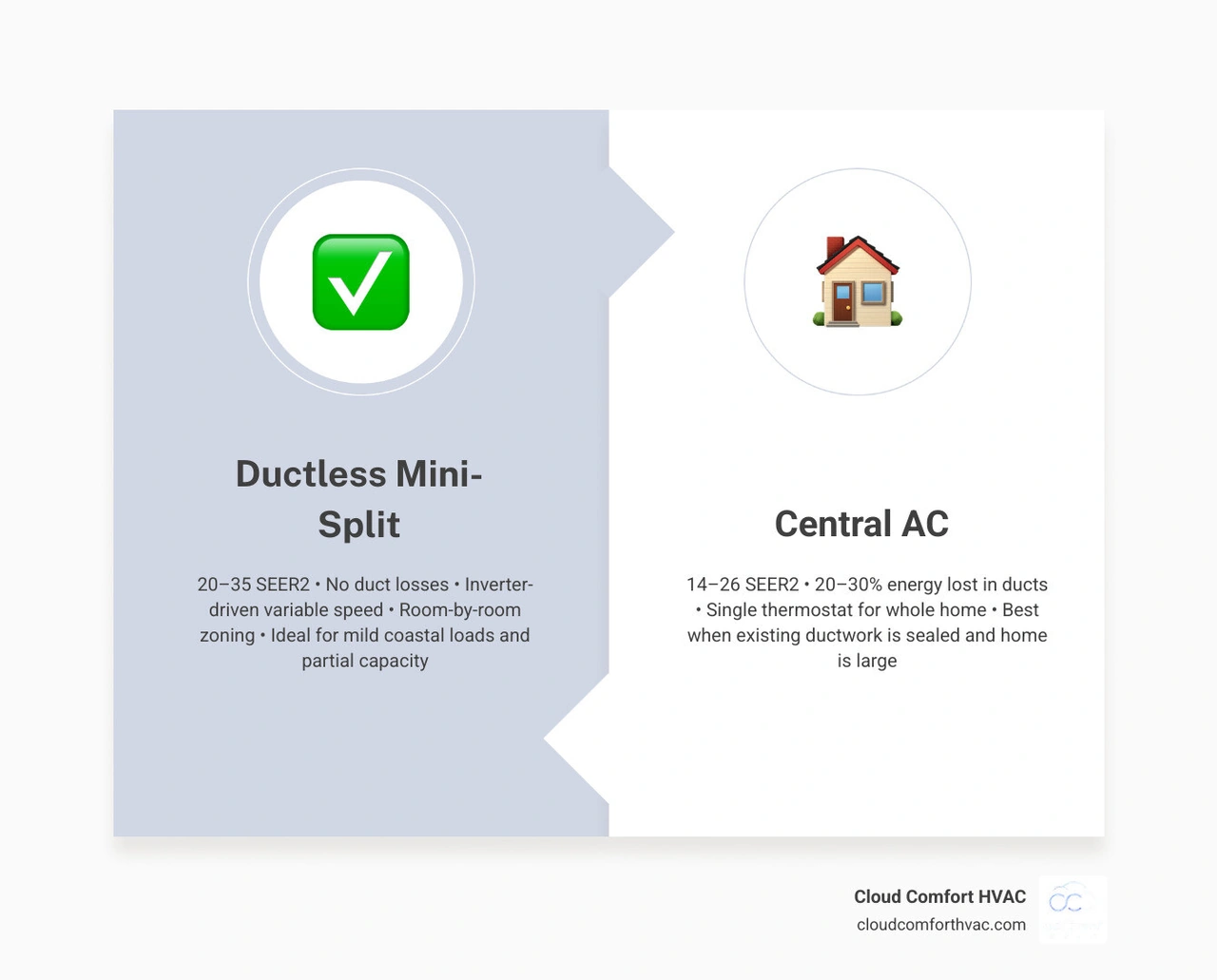
- Ductless mini-splits typically achieve 20–35 SEER2, while most central AC systems top out around 14–26 SEER2
- Central AC systems lose 20–30% of cooling energy through ductwork, according to the EPA and Energy Star — ductless systems eliminate that loss entirely
- In mild coastal climates where cooling loads are low and temperatures rarely spike, ductless systems run at partial capacity more often, which is where their inverter-driven compressors are most efficient
- Zoning lets you cool only the rooms you are using, which is a major advantage in homes with varying occupancy
- For homes without existing ductwork, ductless is almost always the more efficient and more practical choice
- For homes with well-maintained, sealed ductwork, a high-efficiency central system can still be competitive
The mild marine climate along the South Bay coast — think overcast mornings, cool ocean breezes, and low humidity — actually plays to the strengths of ductless heat pumps more than people realize. You are not running your system at full blast all day. You are making small, targeted adjustments. That is exactly what ductless technology was built for.
This guide walks you through everything you need to know to make the right call for your home and your energy bills.
How Ductless Mini-Splits and Central AC Work in Coastal Environments
To understand why one system pulls ahead in energy efficiency, we first have to look at how they operate under the unique atmospheric conditions of coastal Southern California. The combination of high morning humidity, cool ocean breezes, and mild afternoon temperature swings requires a system that can adapt quickly without wasting energy.
Traditional Central Air Conditioning
Central AC relies on a "broadcast" approach. It uses a single, centrally located outdoor condenser and an indoor evaporator coil (typically located in an attic, closet, or garage) to cool a large volume of air at once. This cooled air is then pushed by a powerful blower fan through a complex network of metal or flexible ducts hidden behind your walls and ceilings.
Because central AC is designed to cool the entire house to a single temperature set on a central thermostat, it operates on a binary cycle: it is either 100% on or completely off. In a coastal environment, this often leads to "short-cycling." The system kicks on, quickly cools the air near the thermostat, and shuts off before it can properly balance the temperature or pull moisture out of the air in further-away rooms.
Ductless Mini-Split Systems
Ductless systems take a highly targeted approach. Instead of sending conditioned air through a maze of ducts, they deliver comfort directly to individual spaces. A ductless setup consists of a small outdoor compressor unit connected to one or more indoor air handlers mounted on the wall, floor, or ceiling. These components are linked by a narrow conduit housing the power cable, communication lines, and copper refrigerant tubing.
For a deeper look at the mechanics, you can read our detailed Mini Split AC Guide How Do Mini Splits Work.
Because there are no ducts, there is no opportunity for cooled air to escape into unconditioned spaces like a hot attic. Furthermore, ductless systems are powered by advanced variable-speed inverter technology. Instead of turning on and off repeatedly, the compressor adjusts its speed dynamically to match the exact cooling load of the room. This continuous, low-power operation is exceptionally well-suited for the mild, steady temperatures of coastal areas.
Are Ductless Systems More Efficient Than Central AC in a Mild Coastal SoCal Climate?
When evaluating whether are ductless systems more efficient than central ac in a mild coastal socal climate, we have to look at both raw laboratory ratings and real-world operational differences.
In terms of raw efficiency, ductless systems are the clear winners. Modern ductless mini-splits routinely achieve ratings between 20 and 35 SEER2 (Seasonal Energy Efficiency Ratio 2). In comparison, standard central air conditioning systems typically range from 14 to 20 SEER2, with only ultra-premium, high-tier central systems reaching up to 26 SEER2.
To explore how these high-efficiency systems operate under California’s strict green initiatives, check out our guide on California Mini Splits Ductless Heat Pumps ACs.
However, the SEER2 rating is only part of the story. The way these systems handle the specific weather patterns of the South Bay and coastal Los Angeles reveals the true efficiency gap.
Why Are Ductless Systems More Efficient Than Central AC in a Mild Coastal SoCal Climate?
The primary driver of energy waste in traditional central systems is the ductwork itself. According to the U.S. Department of Energy, the average home loses roughly 20% to 30% of its cooling energy through duct leaks, poor insulation, and conduction losses.
Consider a typical home in Torrance or Rancho Palos Verdes. During a warm afternoon, the air inside an unconditioned attic can easily reach temperatures well over 100°F. When your central AC pushes cooled air through ducts running through that hot attic, the air absorbs heat before it ever reaches your living spaces. This thermal loss forces your system to work harder and run longer. Ductless systems bypass this entire problem by delivering conditioned air directly into the room.
Another major efficiency advantage is zoning. In a central AC setup, you must cool the entire house even if you are only using a single room, such as a home office during the day or a master bedroom at night. Ductless mini-splits allow you to establish independent comfort zones. You can turn off the cooling in unoccupied guest rooms or living spaces, drastically reducing your overall energy consumption.
For a comprehensive look at how these systems are set up and serviced locally, see our overview of Ductless Mini Split Installation and Repair in California.
When Are Ductless Systems More Efficient Than Central AC in a Mild Coastal SoCal Climate?
The efficiency gap between ductless and central systems becomes even wider under partial load conditions. Because the coastal marine layer keeps our afternoon temperatures relatively mild for most of the year, your home rarely requires maximum cooling capacity.
A traditional single-stage central AC can only run at full speed. When it turns on, it draws a massive spike of electricity, cools the house rapidly, and shuts down. This continuous cycle of starting and stopping is highly inefficient.
Ductless systems, on the other hand, utilize inverter-driven compressors that function like cruise control for your home comfort. If a room only needs a tiny amount of cooling to maintain its target temperature, the compressor will run at a whisper-quiet, ultra-low speed, consuming only a fraction of the power required by a central system.
To see some of the top-performing models that excel under these partial-load coastal conditions, read our review of the Best Ductless Mini Split Air Conditioner 2023.
Key Factors Influencing Efficiency in South Bay and Orange County Homes
While ductless systems hold a clear technological advantage, the actual efficiency you experience in your home depends heavily on local environmental factors, the age of your property, and existing infrastructure.
The Coastal Microclimate and Salt Air Corrosion
Living close to the Pacific Ocean in Manhattan Beach, Hermosa Beach, or Huntington Beach means dealing with salt-laden air and high humidity. Salt air is highly corrosive to the delicate aluminum coils found in outdoor HVAC condensers.
When coils corrode, their ability to transfer heat degrades rapidly, forcing the system to consume more energy to achieve the same cooling effect. Both central ACs and ductless systems are vulnerable to this, but many premium ductless manufacturers design their outdoor units with specialized anti-corrosive coatings (often called "Blue Fin" or "Gold Fin" technology) to protect against marine degradation.
To ensure your system is optimized for these coastal challenges, you can read our specialized Ductless AC Torrance Install Tips.
Home Architecture and Historic Preservation
Many homes in older coastal neighborhoods were built without central heating or cooling. Retrofitting a classic beach bungalow or a mid-century modern home with central AC is incredibly invasive. It requires dropping ceilings, cutting into plaster walls, and sacrificing valuable closet space to run bulky ductwork.
From an efficiency standpoint, installing ducts in a home not originally designed for them often results in tight bends, restricted airflow, and high static pressure—all of which force the blower motor to work harder, reducing overall efficiency. A ductless system requires only a small, three-inch hole through an exterior wall for the refrigerant lines, preserving your home’s architectural integrity and maximizing airflow efficiency.
For residents looking to upgrade their coastal properties, we have put together a guide on selecting an Energy Efficient Air Conditioner Manhattan Beach CA.
Efficiency Metrics Comparison Table
To help visualize how these systems stack up against each other in our local climate, consider the following comparison:
| Efficiency Metric | Ductless Mini-Split Systems | Central Air Conditioning |
|---|---|---|
| Typical SEER2 Ratings | 20 to 35 SEER2 | 14 to 26 SEER2 |
| Duct Energy Loss | 0% (Ductless) | 20% to 30% (Thermal & Leakage) |
| Compressor Technology | Variable-Speed Inverter (Continuous) | Single-Stage, Two-Stage, or Variable |
| Zoning Capabilities | Standard (Room-by-Room Control) | Limited (Requires Complex Damper Systems) |
| Dehumidification Control | Excellent (Continuous Low-Speed Run) | Moderate (Prone to Short-Cycling) |
| Lifespan in Coastal Zones | 12 to 18 Years (With Proper Care) | 10 to 15 Years (Due to Salt Air Exposure) |
Impact of Existing Ductwork on System Selection
If your home already has a duct system installed, the decision-making process changes. Upgrading to a new, high-efficiency central air conditioner can be a highly practical choice if those ducts are in excellent condition.
However, older ductwork is rarely in perfect shape. Over time, duct joints separate, flexible ducts sag or get crushed, and insulation degrades. If you connect a brand-new, high-efficiency central unit to a leaky, uninsulated duct system, you will instantly lose a significant portion of the efficiency you paid for.
Before committing to a central system replacement, it is vital to have a professional test your ductwork's static pressure and leakage rate. If the ducts require extensive sealing, repair, or complete replacement, transitioning to a ductless system often yields much higher long-term energy savings.
For homeowners on the peninsula navigating these choices, our AC Installation Rancho Palos Verdes Guide provides excellent localized advice, and you can learn more about high-efficiency options at Energy Efficient Air Conditioner Rancho Palos Verdes CA.
Local Utility Rebates and Electrification Incentives
California’s aggressive push toward residential electrification makes upgrading to energy-efficient heat pump technology more financially attractive than ever. Because ductless mini-splits are inherently highly efficient heat pumps (providing both heating and cooling), they qualify for some of the most generous rebates available.
Depending on your specific location within the South Bay and Los Angeles area, you may be eligible for:
- LADWP Rebates: The Los Angeles Department of Water and Power offers substantial rebates for residential heat pump installations, with higher tiers of funding reserved for ultra-high-efficiency ductless systems.
- TECH Clean California: This statewide initiative provides significant incentives directly to licensed contractors, which are passed along to homeowners to lower the cost of switching to heat pump technology.
- Federal Tax Credits (Section 25C): Under the Inflation Reduction Act, homeowners can claim tax credits for installing qualified high-efficiency heat pumps.
To explore how these incentives can help you transition to a cleaner, more efficient system, take a look at our guides on securing an Energy Efficient Air Conditioner Los Angeles CA and an Energy Efficient Air Conditioner Carson CA.
Frequently Asked Questions about Coastal HVAC Efficiency
Do mini-splits perform better than central AC in high humidity?
Yes, ductless mini-splits generally perform much better than standard central air conditioners when it comes to managing coastal humidity.
Because coastal Southern California experiences moderate temperatures mixed with damp marine air (especially during the morning "June Gloom"), your home needs dehumidification even when it doesn't need heavy cooling. A traditional central AC turns on, rapidly drops the temperature near the thermostat, and shuts off before it can run long enough to pull moisture out of the air. This leaves your home feeling cold and clammy.
Ductless systems solve this through their variable-speed inverter compressors. By running continuously at a very low speed, they keep the cooling coils cold for extended periods. This allows moisture in the air to continuously condense on the coils and drain safely outside, maintaining a crisp, comfortable indoor environment without overcooling your home.
You can learn more about optimizing indoor air quality and humidity control on the peninsula at Energy Efficient Air Conditioner Palos Verdes Estates CA.
Is central AC ever more efficient than a ductless system?
While ductless systems are almost always more efficient on a room-by-room basis, there are scenarios where a high-efficiency central AC system is a highly practical and effective choice.
If your home has a large, open-concept floor plan with high ceilings, and you already have healthy, well-insulated, and professionally sealed ductwork, upgrading to a modern central heat pump or variable-speed central AC can be incredibly efficient. In these large, unified spaces, a central system can distribute air evenly and maintain a consistent temperature throughout the entire footprint without the need to install multiple indoor ductless heads in every corner.
If you are considering maintaining or upgrading your ducted system, you can explore our comprehensive AC Services in Torrance CA.
How does salt air affect the lifespan of coastal HVAC systems?
Salt air is one of the toughest environmental challenges an HVAC system can face. The sodium chloride in the marine breeze accelerates the oxidation of metals, leading to premature corrosion of the outdoor unit’s condenser coils, electrical connections, and fan motor.
Unprotected systems located within three miles of the beach can see their operational lifespan cut short by several years. To protect your investment, we recommend:
- Selecting outdoor units with factory-applied anti-corrosive coil coatings.
- Scheduling regular preventative maintenance, including professional coil rinses to remove accumulated salt crust.
- Placing the outdoor unit in a location that is shielded from direct, prevailing ocean winds while still allowing for proper airflow clearance.
For expert tips on keeping your coastal system running reliably year after year, refer to our guide on the Best Ductless AC Installation Torrance.
Conclusion
When deciding between a ductless system and central AC for your coastal Southern California home, the right choice ultimately comes down to your property’s layout, the condition of your existing ductwork, and your personal comfort goals.
For most coastal homes—especially those with unique architectural layouts, multi-story floor plans, or no pre-existing ductwork—ductless mini-split systems offer unmatched efficiency, precise zoning, and superior humidity management.
At Cloud Comfort HVAC, we specialize in delivering eco-friendly, energy-efficient comfort solutions tailored to the unique microclimates of Rancho Palos Verdes, Manhattan Beach, Torrance, Culver City, and Carson. As a trusted Daikin partner, we back our expert installations with industry-leading warranties and our signature 1-year Comfort Promise.
Ready to experience quiet, customized, and highly efficient comfort in your home? Explore our Ductless AC Systems or contact us today to schedule a personalized consultation with our friendly, local experts.
Have an HVAC or plumbing question?
Our Torrance comfort experts are here to help — no pressure, just honest answers.
Ask an Expert