Environmental Benefits of Switching to a Heat Pump in California 2025
June 12, 2026

Why the Environmental Benefits of Switching to a Heat Pump in California Matter Right Now
The environmental benefits of switching to a heat pump in California are significant — and if you want the short version, here they are:
Key environmental benefits at a glance:
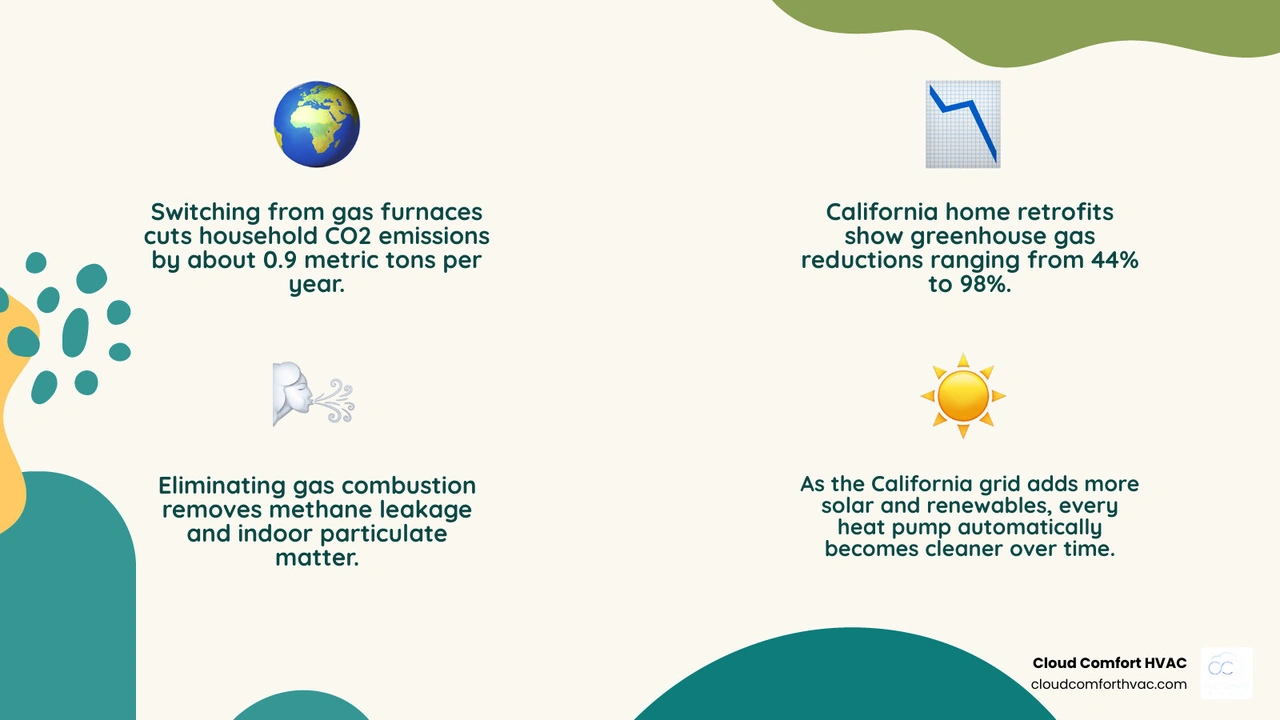
- Fewer greenhouse gas emissions — Switching from a gas furnace to a heat pump can cut energy-related CO2 emissions by roughly 0.9 metric tons per year per household
- Dramatic GHG reductions — Real-world California home retrofits showed greenhouse gas reductions ranging from 44% to 98%
- Cleaner air indoors — Eliminating gas combustion reduces methane leakage and indoor particulate matter
- Grid-connected clean energy — Heat pumps run on electricity, so as California's grid gets greener, your home automatically gets cleaner too
- Supports state climate goals — Heating and cooling account for 25% of California's greenhouse gas emissions; heat pumps directly attack that number
- Massive efficiency gains — Heat pumps operate at 200% to 400% efficiency by moving heat rather than burning fuel to create it
California has set one of the most ambitious climate targets in the world: carbon neutrality by 2045. Getting there means tackling buildings head-on, since heating and cooling are responsible for roughly a quarter of the state's total greenhouse gas emissions. For homeowners in Southern California communities like Torrance, Manhattan Beach, and Culver City, that challenge is also an opportunity.
Gas furnaces and older air conditioning systems burn fossil fuels or rely on energy-hungry electric resistance heating. Heat pumps do something fundamentally different — they move heat from one place to another using electricity, which means they can deliver far more useful energy than they consume. As California's electrical grid continues adding solar, wind, and other renewables, every heat pump in a California home becomes a little cleaner every year without any changes to the equipment itself.
That compounding effect is what makes the decision to switch so timely — and so consequential for both your home and the broader environment.
Environmental Benefits of Switching to a Heat Pump in California
When we evaluate the carbon footprint of a typical home, heating and cooling are almost always the largest contributors. Nationwide, using fossil fuels to heat water, warm indoor air, and cook food inside homes and businesses was responsible for 13% of the country’s greenhouse gas emissions in 2022. In California, where the climate is relatively mild but the population is dense, heating and cooling produce a staggering 25% of the state's greenhouse gas emissions.
Over 6.1 million single-family homes in California currently rely on natural gas for space heating. Every time a traditional gas furnace kicks on, it burns fossil fuels directly on-site, releasing carbon dioxide, nitrous oxides, and trace amounts of unburned methane directly into our atmosphere.
By upgrading to an electric heat pump, you eliminate this on-site combustion entirely. Because heat pumps run on electricity, they tie your home's climate control directly to California's electrical grid, which is rapidly transitioning to 100% clean, renewable energy. Real-world field demonstrations across California have shown that retrofitting homes with low-global warming potential (GWP) heat pumps reduces greenhouse gas emissions by 44% to 98% compared to baseline natural gas systems.
For coastal homeowners looking to make a lasting positive impact on the local environment, scheduling a Heat Pump Installation Manhattan Beach CA is one of the most effective single steps you can take to slash your household's carbon footprint.
How Heat Pumps Outperform Traditional HVAC Systems in Efficiency
To understand why the environmental benefits of switching to a heat pump in California are so pronounced, we have to look at the fundamental thermodynamics of how these systems operate.
Traditional heating systems, like natural gas or propane furnaces, generate heat by burning fuel. Even a brand-new, high-efficiency condensing gas furnace maxes out at around 96% to 98% efficiency — meaning some energy is always lost in the combustion and exhaust process. Older furnaces can operate at efficiencies as low as 80% or worse. Electric resistance heaters (like baseboard heaters or portable space heaters) convert electricity directly into heat, which limits them to a maximum theoretical efficiency of 100%.
Heat pumps, on the other hand, do not generate heat. Instead, they use a refrigerant loop and a compressor to absorb ambient heat from the outdoor air and transfer it indoors. Because they are simply moving heat rather than creating it, heat pumps can be anywhere from 200% to 400% efficient. This means that for every single unit of electricity the system consumes, it delivers two to four units of useful heating or cooling energy into your living space.
| HVAC System Type | Fuel Source | Operating Efficiency | Key Environmental Impact |
|---|---|---|---|
| Standard Heat Pump | Electricity | 200% – 400% | Zero on-site emissions; powered by an increasingly green electric grid |
| High-Efficiency Gas Furnace | Natural Gas | 90% – 98% | Direct fossil fuel combustion; releases CO2 and methane leaks |
| Older Gas Furnace | Natural Gas | 80% or lower | Heavy fossil fuel consumption; high carbon footprint |
| Electric Resistance / Baseboard | Electricity | 100% | High electricity draw; puts major strain on the grid |
Replacing outdated furnaces and air conditioners with electric heat pumps can cut a household’s heating and cooling energy use by 31% to 47%. Additionally, heat pumps use up to 60% less energy than old-fashioned electrical baseboard or space heaters.
By dramatically lowering the total amount of energy required to keep your home comfortable, heat pumps ease the overall demand on our power grid. To learn more about how this technology achieves these remarkable numbers, explore the Advantages of Heat Pumps for Energy Efficiency.
Maximizing the Environmental Benefits of Switching to a Heat Pump in California
While a heat pump is incredibly efficient on its own, you can maximize its environmental benefits by pairing it with other home energy upgrades. In Southern California communities like Rancho Palos Verdes, where sunny days are abundant, integrating a heat pump with a home solar panel system is a game-changer.
Under California’s NEM 3.0 solar billing rules, the export value of solar energy sent back to the grid is lower than it used to be. This makes "self-consumption" — using your solar power directly inside your home rather than exporting it — the smartest way to manage your energy. By running your highly efficient heat pump on the clean electricity generated right on your rooftop, you run your home on 100% self-generated, zero-emission energy.
Adding a home battery storage system allows you to store excess daytime solar energy and use it to power your heat pump during peak evening hours (usually between 4:00 PM and 9:00 PM) when grid electricity is most expensive and relies on fossil-fuel-powered peaker plants. This strategy lowers your overall utility impact and ensures your home remains comfortable during hot summer days without relying on fossil fuels.
If you're ready to transition your home to a clean, self-sustaining system, starting with a professional Heat Pump Installation Rancho Palos Verdes CA is the perfect foundation.
The Role of Refrigerants and New Regulations in California
While heat pumps are incredibly effective at reducing carbon emissions, they do rely on chemical refrigerants to transfer heat. Historically, the HVAC industry relied heavily on hydrofluorocarbons (HFCs) like R-410A. While R-410A does not deplete the ozone layer, it has a high Global Warming Potential (GWP) of 2,088. If a system experiences a refrigerant leak, these gases can escape into the atmosphere and act as potent greenhouse gases.
To address this, California has been at the forefront of strict refrigerant regulations. The federal AIM Act has initiated a phasedown of high-GWP HFCs nationwide. In California, the California Air Resources Board (CARB) has implemented regulations that limit the GWP of refrigerants used in new residential air conditioning and heat pump systems to 750 or lower.
This regulatory shift has pushed manufacturers to transition to next-generation refrigerants like R-32 (which has a GWP of 675) and R-454B (with a GWP of 466). These new refrigerants not only reduce the direct climate impact of potential leaks by over 70%, but they also offer superior thermodynamic properties. For example, R-32 can improve system operating efficiency by up to 10% compared to older R-410A systems, further reducing the electricity needed to run the system.
Long-Term Environmental Benefits of Switching to a Heat Pump in California Today
Some homeowners wonder if they should wait to replace their aging HVAC systems until ultra-low or zero-GWP natural refrigerant systems (like those using carbon dioxide or ammonia) become widely available for residential use. However, comprehensive lifecycle emissions analyses show that waiting is rarely the most environmentally friendly choice.
The climate benefits of immediate electrification far outweigh the impact of waiting. Over a typical 15-year equipment lifespan, a heat pump using a standard refrigerant will save roughly 13.5 metric tons of CO2 emissions simply by avoiding natural gas combustion. Even when you account for potential refrigerant leakage over the system's lifetime, the net emissions savings remain overwhelmingly positive.
Additionally, modern installations utilize advanced leak-detection techniques and highly durable materials to minimize the risk of any refrigerant escaping. Making the switch today allows you to immediately stop burning fossil fuels in your home, supporting California’s goal of rapid building decarbonization. You can read more about making sustainable heating choices in our guide on Eco Friendly Heating.
Indoor Air Quality and Public Health Impacts
When we discuss the environmental benefits of switching to a heat pump in California, we must also look at the indoor environment. Most people spend between 85% and 90% of their time indoors, making indoor air quality a crucial factor for public health.
Gas-burning furnaces, water heaters, and stoves are common sources of indoor air pollution. Even when turned off, gas infrastructure can experience trace methane leakage. When operating, gas combustion releases harmful combustion byproducts directly into your home's air, including:
- Carbon monoxide (CO)
- Nitrogen dioxide (NO2)
- Formaldehyde
- Fine particulate matter (PM2.5)
These pollutants are known triggers for respiratory conditions like asthma, allergies, and chronic obstructive pulmonary disease (COPD). Because heat pumps run entirely on electricity, they eliminate combustion-related pollutants from your home.
Furthermore, modern heat pumps feature advanced, multi-stage air filtration systems. Whether you choose a central ducted heat pump or a ductless mini-split system, these units continuously circulate and filter your indoor air, capturing dust, pollen, pet dander, and outdoor wildfire smoke.
If your current system is failing or circulating poor-quality air, addressing it quickly is essential. Securing a professional Heat Pump Repair Torrance CA or upgrading to a modern, filtered system will keep your indoor air safe, clean, and healthy for your family.
Frequently Asked Questions About Heat Pump Environmental Impact
How much do heat pumps reduce greenhouse gas emissions in California?
Switching from a standard natural gas furnace to an electric heat pump saves approximately 0.9 metric tons of CO2 emissions per year for a single household. When looking at full-home electrification retrofits across various California climate zones, researchers have documented total greenhouse gas emissions reductions ranging from 44% to 98%.
Because California’s electrical grid is on a legally mandated path to be 100% carbon-free by 2045, the carbon footprint of your heat pump will automatically decrease every year as more wind, solar, and hydro power are integrated into the grid.
What is the projected impact of California's 6 million heat pumps by 2030 goal?
California has set an ambitious target to install 6 million electric heat pumps across the state by 2030. To support this effort, the state formed the California Heat Pump Partnership, bringing together grid operators, manufacturers, and contractors to streamline adoption.
Meeting this goal is projected to reduce millions of metric tons of cumulative greenhouse gas emissions, significantly accelerating the state's progress toward carbon neutrality. It also helps establish zero-emission standards for space and water heating equipment, paving the way for sustainable building design across the country.
Do heat pumps work efficiently in Southern California's coastal climates?
Absolutely. In fact, Southern California’s coastal areas — including Torrance, Carson, and Culver City — offer the absolute ideal operating conditions for air-source heat pumps. Because our winter temperatures rarely drop below freezing and our summers remain relatively mild, heat pumps do not have to work hard to extract or reject heat.
This moderate climate allows heat pumps to run at their maximum efficiency year-round. To learn more about how ductless systems and mini-splits provide targeted, hyper-efficient comfort in our local beach cities, check out our comprehensive guide on California Mini Splits Ductless Heat Pumps ACs.
Conclusion
The environmental benefits of switching to a heat pump in California are clear. By moving away from fossil fuels and utilizing highly efficient heat transfer technology, Southern California homeowners can play a direct role in reducing greenhouse gas emissions, improving local air quality, and supporting a clean energy grid.
At Cloud Comfort HVAC, we are proud to provide expert, eco-friendly heating and cooling solutions to our neighbors in Torrance, Manhattan Beach, Rancho Palos Verdes, and the surrounding areas. We specialize in installing, maintaining, and repairing high-efficiency heat pump systems that keep your home perfectly comfortable while protecting the environment.
Our team is dedicated to providing fast, reliable service, transparent pricing, and strong Daikin warranties backed by our 1-year Comfort Promise. When you are ready to make the switch to a cleaner, more sustainable home, we are here to help you every step of the way.
Ready to reduce your carbon footprint and upgrade your home's comfort? Schedule your eco-friendly upgrade with Cloud Comfort HVAC today!
Have an HVAC or plumbing question?
Our Torrance comfort experts are here to help — no pressure, just honest answers.
Ask an Expert